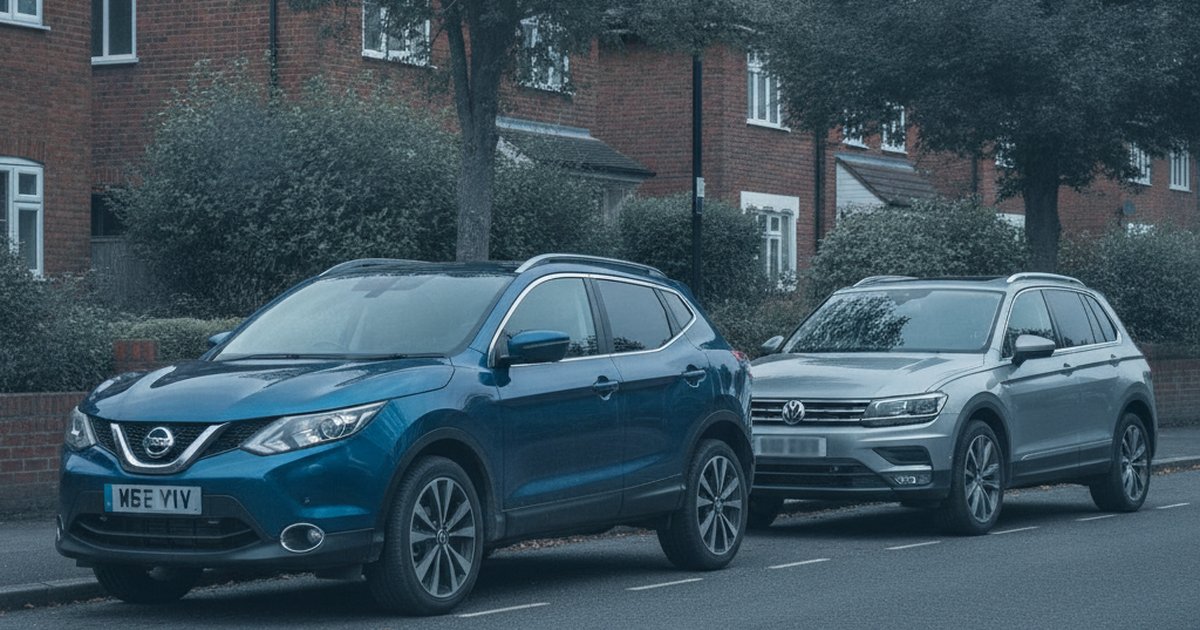
The Qashqai is the crossover Britain actually bought. The Tiguan is the one buyers aspired to when they had a bit more to spend. Both sit in the same segment, both get driven the same way by families and commuters, and both have been on UK roads in huge numbers since 2010. We've pulled 6,554,950 MOT tests across the shared 2010-2021 age-matched window to see whether the Tiguan's premium badge and higher used price actually translate into a tougher car, or whether you're just paying more for the same reliability the Qashqai gives you for less.
The data isn't close, as it turns out. But the reasons behind the gap matter more than the headline number, especially if you're trying to work out which one suits how you actually drive.
The short version: The VW Tiguan wins this comparison by 152 points and a 5.9 percentage point pass rate gap across 6,554,950 combined MOT tests. It picks up fewer defects per test than the Qashqai, and its advantage is biggest in the areas that matter most: brakes, electrics, and steering. The Qashqai is still a sound buy, especially in its stronger recent years, but it fails its MOTs more often and racks up more issues per test throughout its life.
The Data Verdict
The VW Tiguan is the more reliable car, by 152 points
Like-for-like comparison across the years both cars were on sale (2010-2021), from 6,554,950 real DVSA MOT tests. Scores out of 1000, higher is better.
Head-to-Head: The Numbers (2010-2021)
| Metric | Nissan Qashqai | VW Tiguan |
|---|---|---|
| Reliability score (/1000) | 490 | 642 |
| MOT pass rate | 79.3% | 85.2% |
| First MOT pass rate (age 3) | 86.9% | 88.5% |
| Average defects per test | 1.92 | 1.57 |
| Typical annual mileage | 7,419 mi | 7,974 mi |
| MOT tests analysed | 5,070,699 | 1,484,251 |
| Vehicles tracked | 536,605 | 179,120 |
Pass Rate and Score, Year by Year
| Year | Nissan Qashqai pass (score) | VW Tiguan pass (score) | Stronger |
|---|---|---|---|
| 2010 | 71.5% (419) | 78.5% (638) | VW Tiguan |
| 2011 | 72.9% (417) | 80.3% (650) | VW Tiguan |
| 2012 | 73.8% (413) | 81.7% (660) | VW Tiguan |
| 2013 | 75.9% (439) | 83.7% (669) | VW Tiguan |
| 2014 | 81.1% (552) | 84.5% (643) | VW Tiguan |
| 2015 | 82.9% (556) | 86.2% (648) | VW Tiguan |
| 2016 | 84.2% (545) | 87.9% (664) | VW Tiguan |
| 2017 | 86.1% (544) | 88.6% (643) | VW Tiguan |
| 2018 | 86.6% (542) | 87.8% (598) | VW Tiguan |
| 2019 | 88.4% (566) | 89.3% (622) | VW Tiguan |
| 2020 | 90.2% (574) | 89.4% (595) | VW Tiguan |
| 2021 | 89.9% (539) | 88.1% (576) | VW Tiguan |
Shared years only. Nissan Qashqai data also covers 2022; VW Tiguan data also covers 2022-2023, covered in the full year-by-year guides below.
What Actually Fails on Each
Recorded defects and advisories per 100 MOT tests by DVSA inspection category, 2010-2021. A test can record more than one defect.
Nissan Qashqai
- Tyres, wheels and suspension: 73.1 per 100 tests typically around 63,500 miles
- Brakes: 39.9 per 100 tests typically around 62,500 miles
- Other: 16.1 per 100 tests typically around 63,500 miles
- Lights and electrics: 15.5 per 100 tests typically around 70,000 miles
- Visibility (wipers, washers, windscreen): 12.5 per 100 tests typically around 66,000 miles
VW Tiguan
- Tyres, wheels and suspension: 76.7 per 100 tests typically around 63,000 miles
- Brakes: 31.5 per 100 tests typically around 59,000 miles
- Other: 12.1 per 100 tests typically around 60,000 miles
- Lights and electrics: 7.7 per 100 tests typically around 71,000 miles
- Visibility (wipers, washers, windscreen): 7.4 per 100 tests typically around 64,000 miles
The Best Year to Buy Each
Reliability scores are age-adjusted: each year is judged against other cars of the same age. So when an older year out-scores a newer one, it means it holds up unusually well for its age, not that it will need less work than a much newer car. How our scores work.
Why Does the Tiguan Come Out on Top?
The gap between these two isn't marginal. The Tiguan's pass rate sits comfortably above the Qashqai's across nearly every year in the shared window, and it manages this while covering slightly more miles a year on average, not fewer. That detail matters: the Tiguan isn't winning because it's babied by low-mileage owners. It's winning despite being driven marginally harder.
Where the two cars really separate is defects per test. The Qashqai picks up meaningfully more issues per MOT than the Tiguan across the board. It's not one rogue category dragging the average down either, it's a broad pattern across brakes, electrics, visibility and steering. That points to a car that wears in more places at once, rather than one specific weak point you can watch for and avoid.
Volkswagen's badge premium gets plenty of stick from buyers who assume it's just marketing, but the MOT data backs up the perception here. The Tiguan of this era shares its underpinnings and engines with the Golf and Passat, both cars with strong reputations in their own right, and that engineering carries over.
What Do the Defect Patterns Actually Mean for a Buyer?
Both cars share the same number one problem: tyres, wheels and suspension. That's normal for this class of vehicle. Taller crossovers put more load through suspension components and alloy wheels than a standard hatchback, and it's not a reason to avoid either car. Budget for it either way.
The real story is in the categories below that. The Qashqai's electrics and lights defect rate is roughly double the Tiguan's, and its steering defect rate is more than three times higher. Steering issues can escalate from an advisory to a dangerous fault if ignored, so it's worth having a specialist check the steering rack and tie rod ends closely on any Qashqai you're viewing, particularly one that's covered higher mileage.
Brakes are the one area where the Qashqai does relatively better by comparison, though it still lags the Tiguan here too. If you're buying either car privately, a pre-purchase inspection that specifically checks brake wear, steering play and the usual suspension bushes will tell you more than the service book will.
Key point: The Qashqai's problems are spread across more systems rather than concentrated in one area, which makes it harder to inspect your way around. The Tiguan's faults are lower in volume across nearly every category, not just one.
Which Years Should You Buy or Avoid?
Early examples of both cars tell a familiar story: reliability climbs steadily as each generation matures and manufacturers iron out early production issues. The first Qashqais from 2010 to 2012 sit well below the model's later years, and the same climb, though less dramatic, applies to the early Tiguan.
For the Qashqai, the strongest year for its age is 2020, though buyers on a tighter budget shouldn't write off the mid-2010s cars either. They're a real step up from the 2010-2012 examples and remain widely available. For the Tiguan, 2016 stands out as holding up unusually well for its age, a genuine value pick if you're comfortable with a car that's now the best part of a decade old and will need the usual attention that age brings regardless of its strong test history.
Neither car should be bought on year alone. Full service history and evidence of proactive suspension and brake work matter more than the registration plate. For the complete picture on every model year, see our full Nissan Qashqai year-by-year breakdown and our full VW Tiguan year-by-year breakdown before you commit to a specific age.
Which Car Suits Which Kind of Buyer?
If you're after the lowest purchase price and the widest choice of examples on the used market, the Qashqai remains the sensible default. It's cheaper to buy, cheaper to insure in most cases, and parts are everywhere given how many were sold. Just go in accepting you'll likely face more frequent minor faults over the car's life, and budget accordingly for suspension and electrical bits.
If you can stretch to a Tiguan, the data justifies the extra outlay. It fails less often, needs fewer repairs per test, and the areas where it beats the Qashqai (steering, electrics) are exactly the sort of things that turn into expensive garage visits if neglected. For a buyer planning to keep the car for several years and rack up motorway miles, that lower running friction adds up. What Car? owner satisfaction surveys have historically rated VW ownership experience above Nissan's in this segment too, which lines up with what the MOT data shows here.
Before buying either, always run a check through the official gov.uk MOT history tool or PlateInsight to see the specific car's test record, not just the model average.
Frequently Asked Questions
Is the Nissan Qashqai more reliable than the VW Tiguan?
No. Across 6,554,950 combined MOT tests in the shared 2010-2021 window, the VW Tiguan beats the Qashqai by 152 points and a 5.9 percentage point higher pass rate. The Tiguan also averages fewer defects per test.
Which Nissan Qashqai years should you avoid?
The earliest cars, 2010 to 2012, score noticeably lower for their age than later models. If buying used, models from 2014 onward show a clear improvement, with 2020 standing out as the strongest year for its age. See our full Qashqai year-by-year breakdown for details.
Which VW Tiguan years should you avoid?
Like the Qashqai, the earliest Tiguans (2010-2012) trail the model's later years. 2016 stands out as an unusually strong year for its age, making it a solid value pick, though buyers should still expect the wear that comes with an older car. See our full Tiguan year-by-year breakdown for the complete picture.
Which is cheaper to run day-to-day, the Qashqai or Tiguan?
The Qashqai typically costs less to insure and its parts are more widely available given how many were sold in the UK. However, its higher defects-per-test rate means it's likely to need more frequent minor repairs than the Tiguan over the same ownership period.
Which is the better first car, a Qashqai or a Tiguan?
The Qashqai is generally the easier and cheaper first car thanks to lower insurance groups and purchase prices. The Tiguan's stronger reliability record is appealing, but its higher used values and running costs make it a less obvious choice for a first-time buyer on a tight budget.
Our Verdict
A reliable model is only half the story. The exact Nissan Qashqai or VW Tiguan you are looking at could be clocked, on outstanding finance, or a past write-off. Check the specific car before you commit.
Numbers on a page only tell you about the model average, not the specific car sitting on a driveway with a price sticker in the window. Whichever way you lean, run the registration through PlateInsight before you hand over any money. You get 5 free credits to check full MOT history, mileage patterns and defect records on the actual vehicle, not just the badge on the boot.
You might also like
Check Any Vehicle's Full History
MOT results, mileage timeline, AI health score, and market valuations. New users get 5 free credits.