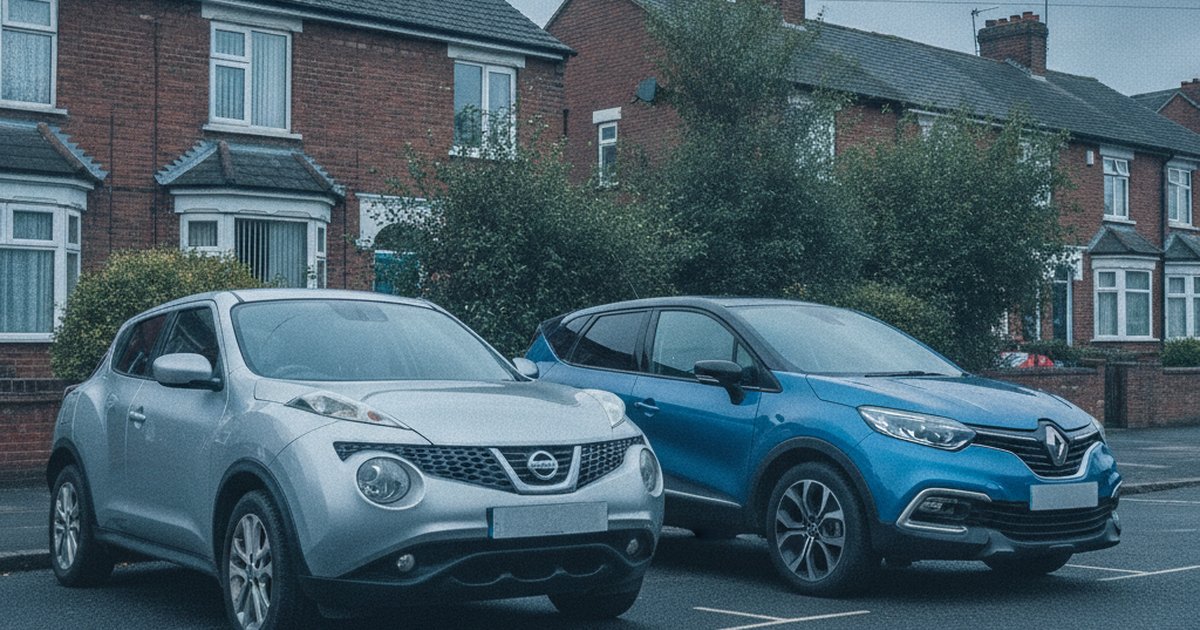
The Nissan Juke and Renault Captur have been squabbling over the same small-crossover buyers since 2013, and it turns out their MOT records are just as evenly matched as their showroom rivalry. We've pulled 3,178,185 MOT tests covering both models across their shared 2013-2019 production years to see whether one actually holds up better than the other.
It's close. Genuinely close. But close doesn't mean identical, and the way each car fails its MOT tells you something useful about which one suits your driving.
The short version: The Juke and Captur are statistically tied on reliability, separated by just 2 points out of 1000 across 3,178,185 MOT tests. The Captur pulls slightly ahead on pass rate and racks up fewer defects per test, while the Juke's first-MOT pass rate is stronger, which suggests it doesn't age quite as gracefully as it starts out. Neither car wins outright; your choice should come down to which faults you'd rather deal with.
The Data Verdict
Too close to call: 2 points between them across 3,178,185 MOT tests
Like-for-like comparison across the years both cars were on sale (2013-2019), from 3,178,185 real DVSA MOT tests. Scores out of 1000, higher is better.
Head-to-Head: The Numbers (2013-2019)
| Metric | Nissan Juke | Renault Captur |
|---|---|---|
| Reliability score (/1000) | 464 | 466 |
| MOT pass rate | 80.7% | 82.4% |
| First MOT pass rate (age 3) | 88.3% | 85.2% |
| Average defects per test | 1.64 | 1.34 |
| Typical annual mileage | 6,413 mi | 6,003 mi |
| MOT tests analysed | 2,093,621 | 1,084,564 |
| Vehicles tracked | 228,563 | 133,104 |
Pass Rate and Score, Year by Year
| Year | Nissan Juke pass (score) | Renault Captur pass (score) | Stronger |
|---|---|---|---|
| 2013 | 75.7% (421) | 75.9% (405) | Nissan Juke |
| 2014 | 78.8% (463) | 78.5% (423) | Nissan Juke |
| 2015 | 80.9% (472) | 80.5% (436) | Nissan Juke |
| 2016 | 82.8% (483) | 84.1% (503) | Renault Captur |
| 2017 | 85.1% (489) | 86.3% (516) | Renault Captur |
| 2018 | 86.1% (488) | 86.0% (490) | Even |
| 2019 | 86.4% (470) | 87.3% (500) | Renault Captur |
Shared years only. Nissan Juke data also covers 2010-2012, 2020-2022; Renault Captur data also covers 2020-2022, covered in the full year-by-year guides below.
What Actually Fails on Each
Recorded defects and advisories per 100 MOT tests by DVSA inspection category, 2013-2019. A test can record more than one defect.
Nissan Juke
- Tyres, wheels and suspension: 67.1 per 100 tests typically around 51,000 miles
- Brakes: 37.0 per 100 tests typically around 52,500 miles
- Other: 12.3 per 100 tests typically around 51,000 miles
- Visibility (wipers, washers, windscreen): 11.4 per 100 tests typically around 50,500 miles
- Lights and electrics: 9.4 per 100 tests typically around 54,500 miles
Renault Captur
- Tyres, wheels and suspension: 63.6 per 100 tests typically around 45,500 miles
- Brakes: 25.7 per 100 tests typically around 45,000 miles
- Other: 11.3 per 100 tests typically around 45,000 miles
- Lights and electrics: 10.3 per 100 tests typically around 47,000 miles
- Visibility (wipers, washers, windscreen): 7.0 per 100 tests typically around 44,500 miles
The Best Year to Buy Each
Reliability scores are age-adjusted: each year is judged against other cars of the same age. So when an older year out-scores a newer one, it means it holds up unusually well for its age, not that it will need less work than a much newer car. How our scores work.
Why Are These Two So Evenly Matched?
A 2-point gap on a 1000-point scale is noise, not a verdict. These cars share a platform lineage, engine families and a fair bit of supplier hardware under the Renault-Nissan alliance, so that's not much of a surprise. What's more interesting is how each car arrives at a near-identical score by a different route.
The Captur has the better overall pass rate and a lower defects-per-test average, meaning that when a Captur does fail, it tends to fail on fewer things. The Juke, on the other hand, has a stronger first MOT pass rate than the Captur, which suggests it leaves the factory in slightly better shape but degrades faster once wear and mileage start to bite. Put simply, the Captur ages more evenly and the Juke front-loads its reliability.
Annual mileage is broadly similar between the two, so this isn't a case of one being driven harder than the other. The difference is baked into the cars themselves, not the owners.
What Do the Defect Patterns Actually Mean for a Buyer?
Both cars share the same weak point: tyres, wheels and suspension is the biggest defect category for each, which is normal for small crossovers running the tighter suspension geometry needed for that raised ride height. Nothing alarming there. Just budget for tyres and bushes as these cars pass 45,000-55,000 miles.
The real split is brakes. The Juke throws up brake-related defects at a notably higher rate than the Captur. That's not a dangerous-defect red flag in the data, but it does mean Juke owners should check pad and disc wear between services more diligently, particularly on cars past 50,000 miles. The Captur's brake defect rate is comfortably lower, which lines up with its lower overall defects-per-test figure.
The Juke also picks up more visibility-related faults (wipers, washers, screens) than the Captur. It's a small but recurring theme that points to slightly flimsier trim-level components rather than anything structural. Neither car shows a concerning dangerous defect rate, so this is about running costs and MOT stress, not safety.
Key point: If you're choosing between the two on maintenance grounds alone, the Captur's lower defect rate per test makes it the marginally cheaper car to keep on the road, even though its headline reliability score barely beats the Juke's.
Which Years Should You Buy, and Which Should You Avoid?
Both cars follow the same broad shape: pass rates climb steadily from 2013 through to 2019 as build quality and running gear matured, then plateau. Early 2013 examples of both the Juke and Captur are the weakest in the shared window, with the lowest scores and pass rates of any year compared here. If you're looking at a 2013-2014 car of either badge, budget for more MOT work and check the suspension and brakes closely before buying.
For the Juke, 2017 and 2018 stand out within the shared window, both posting strong scores and pass rates well ahead of the early cars. The data also flags 2010 as a genuine value pick, its age-adjusted score holds up unusually well for its age, though a car that old will still carry more general wear regardless of how strong its MOT record looks on paper.
The Captur's sweet spot sits a year later, with 2016 and 2017 producing its best scores in the shared window, and 2019 continuing that upward trend. Renault's most recent Captur data, just outside the shared comparison window, shows even stronger figures, so the newest examples you can find are probably worth stretching your budget for if reliability is the priority.
For the full year-by-year breakdown of every model year, including scores outside this shared window, see our full Nissan Juke year-by-year breakdown and our full Renault Captur year-by-year breakdown.
Which Car Suits Which Buyer?
If you want a car that's cheap to keep in an MOT centre's good books, lean Captur. Its lower defects-per-test figure and steadier climb in pass rate through 2016-2019 make it the safer long-term bet, particularly if you're planning to keep the car past 60,000 miles.
If you're buying nearly new or want the best chance of sailing through your first MOT, the Juke's higher first-MOT pass rate works in its favour, though be aware it's more likely to need brake attention as it ages. That makes it a reasonable pick for someone changing cars every 3-4 years who won't be around for the higher-mileage brake wear that shows up later.
Either way, don't buy blind. Before handing over money for a used Juke or Captur, run the registration through a proper MOT history check (the gov.uk MOT history checker is free and a good first step) and look specifically at brake and suspension advisories on the last two tests. What Car? owner satisfaction data is also worth checking if you want a second opinion beyond MOT figures alone.
Frequently Asked Questions
Is the Nissan Juke more reliable than the Renault Captur?
Not meaningfully. Across 3,178,185 shared-window MOT tests the two score within 2 points of each other on a 1000-point scale, which counts as a tie. The Captur has a slightly higher pass rate and fewer defects per test, while the Juke has a stronger first-MOT pass rate.
Which Nissan Juke years should you avoid?
2013 is the weakest year in the shared comparison window, with the lowest pass rate and score of any Juke year covered here. 2017 and 2018 are the strongest, with 2010 also standing out as a value pick that holds up well for its age, though it will still carry more general wear than a newer car.
Which Renault Captur years should you avoid?
Like the Juke, 2013 is the Captur's weakest year in the shared window. 2016 and 2017 are its strongest, and data just outside this comparison suggests the newest Capturs continue that upward trend.
Which is cheaper to insure and run, the Juke or the Captur?
Our MOT data doesn't cover insurance premiums directly, but the Captur's lower defects-per-test rate points to lower ongoing MOT and repair costs. For insurance quotes specifically, compare like-for-like trims via a broker or a site such as Auto Trader before deciding.
Which is better as a first car, the Juke or the Captur?
Both are similar in size and running costs, so this comes down to what a new driver is likely to neglect. The Captur's lower overall defect rate makes it slightly more forgiving if servicing gets missed occasionally, while the Juke's stronger first-MOT pass rate suits someone buying nearly new and changing cars every few years.
Our Verdict
A reliable model is only half the story. The exact Nissan Juke or Renault Captur you are looking at could be clocked, on outstanding finance, or a past write-off. Check the specific car before you commit.
Neither of these two is a bad buy, and neither is a clear winner either, so the smart move is to stop guessing and check the actual history of the specific car you're looking at. Search any Juke or Captur's registration on PlateInsight and you get its full MOT record, mileage pattern and advisory history in seconds. New users get 5 free credits to try it.
You might also like
Check Any Vehicle's Full History
MOT results, mileage timeline, AI health score, and market valuations. New users get 5 free credits.