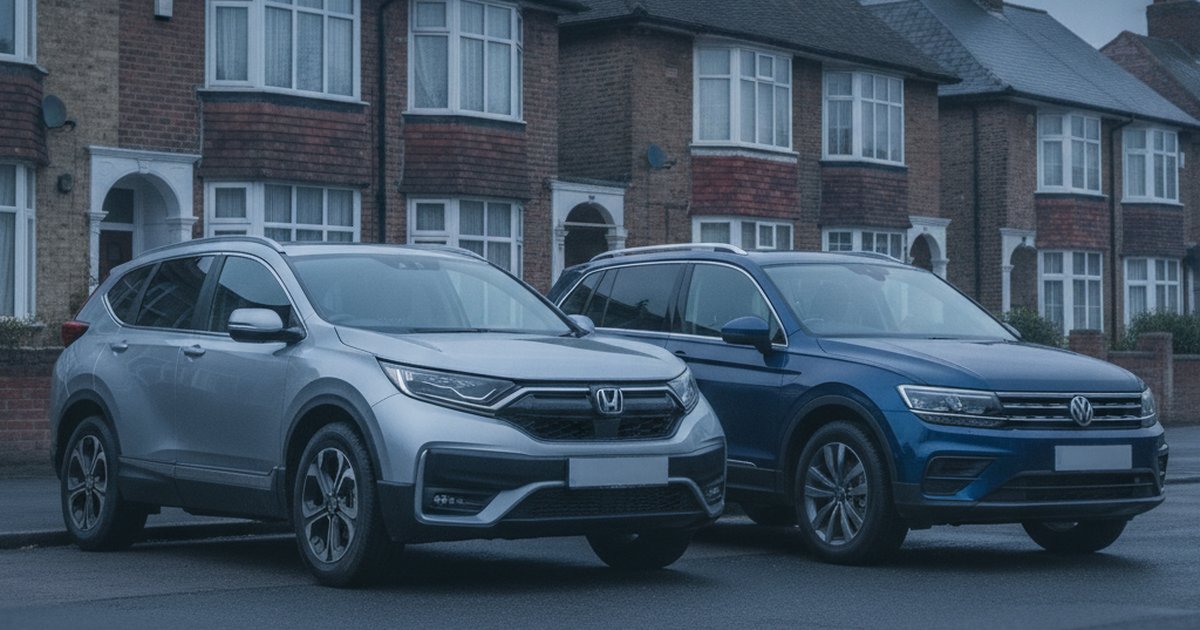
The CR-V and the Tiguan sit in the same driveway conversation for a lot of UK families: mid-size SUV, badge you trust, big boot, years of hard use ahead of it. One carries Honda's reputation for just running forever. The other carries the VW badge and the assumption that German engineering means fewer surprises. We pulled 2,756,175 MOT tests covering both models across shared build years from 2010 to 2022 to see which reputation actually survives contact with the DVSA test lane.
Both cars do proper family SUV mileage, not weekend-only duty. That makes this a fair fight: two hard-working SUVs, tested at scale, over more than a decade of production.
The short version: The Honda CR-V comes out ahead of the VW Tiguan on our reliability score, backed by a higher pass rate and fewer defects logged per test. The gap isn't dramatic on pass rate alone, but the Tiguan racks up meaningfully more suspension and brake issues per 100 tests, which tells you where the money goes once the warranty runs out.
The Data Verdict
The Honda CR-V is the more reliable car, by 99 points
Like-for-like comparison across the years both cars were on sale (2010-2022), from 2,756,175 real DVSA MOT tests. Scores out of 1000, higher is better.
Head-to-Head: The Numbers (2010-2022)
| Metric | Honda CR-V | VW Tiguan |
|---|---|---|
| Reliability score (/1000) | 742 | 642 |
| MOT pass rate | 86.9% | 85.2% |
| First MOT pass rate (age 3) | 91.3% | 88.5% |
| Average defects per test | 1.29 | 1.56 |
| Typical annual mileage | 7,282 mi | 7,975 mi |
| MOT tests analysed | 1,268,391 | 1,487,784 |
| Vehicles tracked | 140,353 | 181,878 |
Pass Rate and Score, Year by Year
| Year | Honda CR-V pass (score) | VW Tiguan pass (score) | Stronger |
|---|---|---|---|
| 2010 | 83.0% (796) | 78.5% (638) | Honda CR-V |
| 2011 | 83.7% (759) | 80.3% (650) | Honda CR-V |
| 2012 | 84.9% (756) | 81.7% (660) | Honda CR-V |
| 2013 | 86.8% (785) | 83.7% (669) | Honda CR-V |
| 2014 | 87.2% (745) | 84.5% (643) | Honda CR-V |
| 2015 | 88.4% (728) | 86.2% (648) | Honda CR-V |
| 2016 | 89.6% (716) | 87.9% (664) | Honda CR-V |
| 2017 | 90.2% (679) | 88.6% (643) | Honda CR-V |
| 2018 | 90.4% (657) | 87.8% (598) | Honda CR-V |
| 2019 | 92.9% (660) | 89.3% (622) | Honda CR-V |
| 2020 | 93.2% (640) | 89.4% (595) | Honda CR-V |
| 2021 | 92.8% (609) | 88.1% (576) | Honda CR-V |
| 2022 | 93.8% (623) | 88.0% (536) | Honda CR-V |
Shared years only. Honda CR-V data also covers 2023; VW Tiguan data also covers 2023, covered in the full year-by-year guides below.
What Actually Fails on Each
Recorded defects and advisories per 100 MOT tests by DVSA inspection category, 2010-2022. A test can record more than one defect.
Honda CR-V
- Tyres, wheels and suspension: 48.1 per 100 tests typically around 64,000 miles
- Brakes: 20.7 per 100 tests typically around 63,500 miles
- Lights and electrics: 15.5 per 100 tests typically around 69,000 miles
- Other: 11.7 per 100 tests typically around 64,000 miles
- Visibility (wipers, washers, windscreen): 9.3 per 100 tests typically around 65,000 miles
VW Tiguan
- Tyres, wheels and suspension: 76.6 per 100 tests typically around 62,500 miles
- Brakes: 31.5 per 100 tests typically around 59,000 miles
- Other: 12.1 per 100 tests typically around 60,000 miles
- Lights and electrics: 7.7 per 100 tests typically around 71,000 miles
- Visibility (wipers, washers, windscreen): 7.4 per 100 tests typically around 64,000 miles
The Best Year to Buy Each
Reliability scores are age-adjusted: each year is judged against other cars of the same age. So when an older year out-scores a newer one, it means it holds up unusually well for its age, not that it will need less work than a much newer car. How our scores work.
Why Does the Honda CR-V Come Out Ahead?
The CR-V's advantage isn't a one-off good year skewing the average. It shows up consistently across the shared 2010-2022 window. Honda's pass rates track ahead of the Tiguan's in almost every equivalent model year, and the defects-per-test figure tells the real story: the average CR-V picks up fewer issues per MOT than the average Tiguan. That's not confined to one component category either. It's broad-based.
Look at the suspension and steering parts specifically. Tyres, wheels and suspension defects turn up at a much higher rate per 100 tests on the Tiguan than on the CR-V, and brakes follow the same pattern. The Tiguan does cover slightly higher annual mileage than the CR-V, so some of that gap comes down to harder use, but not all of it. VW's chassis and running gear on this generation of Tiguan simply throws up more faults for the same test volume. Honda's simpler suspension tuning and its reputation for durable brake components look justified here, not just owner folklore.
What Do the Defect Patterns Actually Mean for a Buyer?
Both cars fail MOTs for the same broad reasons. Tyres, wheels and suspension top the list for each, followed by brakes. That's normal for any SUV doing family duty on UK roads. What differs is the scale. The Tiguan's suspension defect rate is close to 60% higher than the CR-V's, and its brake defect rate is roughly 50% higher too. If you're buying either car used, budget accordingly: a Tiguan is statistically more likely to need bushes, arms, or brake components sorted at MOT time than a CR-V of the same age.
Lights and electrics are the one category where the Tiguan actually looks better, with a lower rate per 100 tests than the CR-V. It's a minor silver lining, but it doesn't offset the bigger costs sitting in the suspension and brakes columns. For a buyer weighing up running costs over five years of ownership, the CR-V's lower overall defects-per-test figure should mean fewer garage visits and a cheaper MOT history, all else being equal.
Key point: The Tiguan's higher defect rate is concentrated almost entirely in suspension and brakes, exactly the components that cost real money to fix. That's the practical difference behind the CR-V's win.
Which Years Should You Avoid on Each Model?
Age matters more than badge here. On the CR-V, older examples from the early 2010s hold up unusually well for their age against Honda's own later cars, but that doesn't mean an older CR-V needs less looking after than a newer one. It simply scores strongly relative to cars of the same vintage. The newer CR-Vs from 2017 onwards post the highest raw pass rates in the dataset, which you'd expect from younger cars with fewer miles, but their age-adjusted scores are lower once you account for how young they are. For a detailed year-by-year read, our full Honda CR-V year-by-year breakdown covers exactly which model years to prioritise and which to be cautious of.
The Tiguan shows a similar shape but starts from a weaker base. Early cars from 2010-2011 have the lowest pass rates in the whole comparison, and while pass rates climb steadily through the mid-2010s, the age-adjusted scores dip again from 2018 onwards. That 2018-2022 stretch is worth treating carefully if you're relying purely on
Which Car Suits Which Kind of Buyer?
If your priority is minimising MOT stress and keeping running costs predictable over high family mileage, the CR-V is the more sensible buy based on this data. It fails less often, throws up fewer defects per test, and its main weak points (tyres, suspension, brakes) are the standard wear items you'd budget for on any used SUV anyway, just at a lower rate than its rival.
The Tiguan still has a case. It's arguably the more premium-feeling cabin and drive, and VW's dealer network and parts availability are strong across the UK, something What Car? owner surveys have flagged as a consistent Tiguan strength even when reliability scores are middling. If you're buying on finance with a warranty attached and value the badge and interior feel more than long-term MOT stress, the Tiguan is a reasonable, if statistically riskier, choice. Just go in expecting more suspension and brake work as the miles climb, and check the specific car's MOT history properly before you commit. A free gov.uk MOT check or a full PlateInsight report will tell you whether the individual example you're looking at fits the pattern or bucks it.
Frequently Asked Questions
Is the Honda CR-V more reliable than the VW Tiguan?
Yes. Across 2,756,175 MOT tests on shared 2010-2022 model years, the CR-V posts a higher reliability score and pass rate than the Tiguan, along with a lower rate of defects per test.
Which Honda CR-V years should you avoid?
No CR-V year in the shared window is a disaster, but the newest years (2017 onwards) post lower age-adjusted scores than older cars did at the same age, despite higher raw pass rates. See our full Honda CR-V year-by-year breakdown for specifics.
Which VW Tiguan years should you avoid?
Early Tiguans from 2010-2011 have the lowest pass rates of the whole range, and scores dip again from 2018 onwards. Our full VW Tiguan year-by-year breakdown covers the strongest years to target.
Does higher mileage make the Tiguan's reliability gap worse?
The Tiguan does average slightly more annual mileage than the CR-V, which explains some of its higher defect rate, but the gap in suspension and brake defects is too large to put down to mileage alone.
Which is the better first family SUV, CR-V or Tiguan?
For a first-time SUV buyer wanting predictable running costs, the CR-V is the safer pick based on this data. The Tiguan is a fine choice if you value the cabin and badge and are prepared for more frequent suspension and brake work.
Our Verdict
A reliable model is only half the story. The exact Honda CR-V or VW Tiguan you are looking at could be clocked, on outstanding finance, or a past write-off. Check the specific car before you commit.
Both of these SUVs are proven family workhorses, but the MOT data backs the Honda's reputation over the Volkswagen's badge appeal. Before you buy either, run the specific registration through PlateInsight. You get 5 free credits to check full MOT history, mileage patterns and defect records on the exact car you're considering, not just the model average.
You might also like
Check Any Vehicle's Full History
MOT results, mileage timeline, AI health score, and market valuations. New users get 5 free credits.