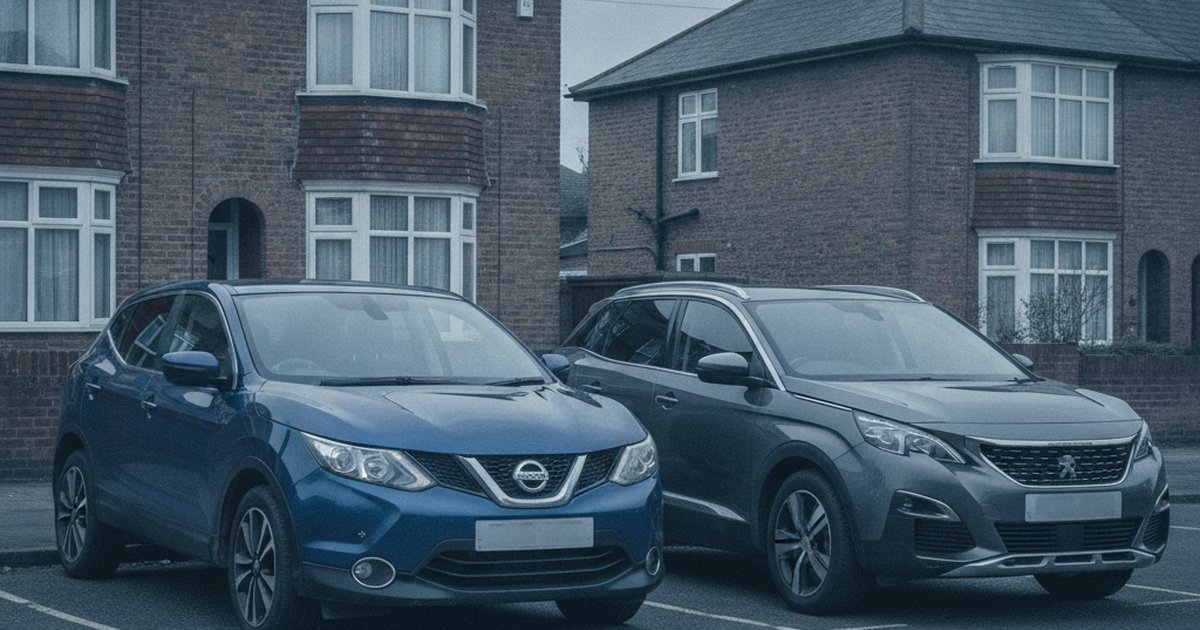
The Qashqai and the 3008 fight over the same driveway. Both are the default choice for families who want an SUV-shaped car without the SUV-shaped fuel bills, and both rack up school-run and motorway miles in roughly equal measure. We've pulled 6,367,849 MOT tests covering both models across their shared 2010-2021 production years to see which one actually holds up to daily use better, and which one just looks like it does.
This isn't a spec sheet comparison. Anyone can tell you the 3008's cabin feels more expensive or that the Qashqai has the bigger boot in some trims. What the DVSA MOT data tells you is what breaks, when, and how often, across hundreds of thousands of real cars owned by real people, not press fleet cars driven gently for a week.
The short version: The Nissan Qashqai comes out ahead of the Peugeot 3008 by 55 points overall, with a 1.4 percentage point edge on pass rate across nearly 6.4 million shared-window MOT tests. Both cars have near-identical annual mileage profiles, so this isn't a case of one being driven harder. The gap comes down to how each car ages, particularly in its first decade on sale.
The Data Verdict
The Nissan Qashqai is the more reliable car, by 55 points
Like-for-like comparison across the years both cars were on sale (2010-2021), from 6,367,849 real DVSA MOT tests. Scores out of 1000, higher is better.
Head-to-Head: The Numbers (2010-2021)
| Metric | Nissan Qashqai | Peugeot 3008 |
|---|---|---|
| Reliability score (/1000) | 490 | 435 |
| MOT pass rate | 79.3% | 78.0% |
| First MOT pass rate (age 3) | 86.9% | 84.5% |
| Average defects per test | 1.92 | 1.82 |
| Typical annual mileage | 7,419 mi | 7,427 mi |
| MOT tests analysed | 5,070,699 | 1,297,150 |
| Vehicles tracked | 536,605 | 136,094 |
Pass Rate and Score, Year by Year
| Year | Nissan Qashqai pass (score) | Peugeot 3008 pass (score) | Stronger |
|---|---|---|---|
| 2010 | 71.5% (419) | 71.3% (382) | Nissan Qashqai |
| 2011 | 72.9% (417) | 75.4% (462) | Peugeot 3008 |
| 2012 | 73.8% (413) | 75.5% (437) | Peugeot 3008 |
| 2013 | 75.9% (439) | 73.2% (314) | Nissan Qashqai |
| 2014 | 81.1% (552) | 77.8% (413) | Nissan Qashqai |
| 2015 | 82.9% (556) | 79.6% (418) | Nissan Qashqai |
| 2016 | 84.2% (545) | 79.4% (364) | Nissan Qashqai |
| 2017 | 86.1% (544) | 84.7% (503) | Nissan Qashqai |
| 2018 | 86.6% (542) | 85.5% (520) | Nissan Qashqai |
| 2019 | 88.4% (566) | 87.0% (541) | Nissan Qashqai |
| 2020 | 90.2% (574) | 89.1% (573) | Even |
| 2021 | 89.9% (539) | 90.3% (656) | Peugeot 3008 |
Shared years only. Nissan Qashqai data also covers 2022; Peugeot 3008 data also covers 2022-2023, covered in the full year-by-year guides below.
What Actually Fails on Each
Recorded defects and advisories per 100 MOT tests by DVSA inspection category, 2010-2021. A test can record more than one defect.
Nissan Qashqai
- Tyres, wheels and suspension: 73.1 per 100 tests typically around 63,500 miles
- Brakes: 39.9 per 100 tests typically around 62,500 miles
- Other: 16.1 per 100 tests typically around 63,500 miles
- Lights and electrics: 15.5 per 100 tests typically around 70,000 miles
- Visibility (wipers, washers, windscreen): 12.5 per 100 tests typically around 66,000 miles
Peugeot 3008
- Tyres, wheels and suspension: 64.7 per 100 tests typically around 60,500 miles
- Brakes: 38.9 per 100 tests typically around 60,000 miles
- Lights and electrics: 27.0 per 100 tests typically around 66,500 miles
- Visibility (wipers, washers, windscreen): 11.8 per 100 tests typically around 66,000 miles
- Other: 11.7 per 100 tests typically around 61,000 miles
The Best Year to Buy Each
Reliability scores are age-adjusted: each year is judged against other cars of the same age. So when an older year out-scores a newer one, it means it holds up unusually well for its age, not that it will need less work than a much newer car. How our scores work.
Why Does the Qashqai Come Out on Top?
The Qashqai's advantage isn't dramatic on paper, but it's consistent. Across nearly every shared model year, its pass rate sits ahead of the 3008's, and the gap is widest in the early-to-mid 2010s cars, exactly the ones most likely to be on sale as budget used buys today. The 3008's 2013 and 2016 model years both dip into genuinely weak scores, dragging down the overall picture in a way the Qashqai never quite matches at the same age.
The two cars are driven almost identically hard, for what it's worth. Annual mileage is essentially the same for both models, so you can't explain the Qashqai's better showing by saying its owners baby it more. This looks like a real difference in how the cars themselves cope with wear, not a difference in ownership habits.
The first MOT pass rate tells a similar story. Both cars fail their first test at similar rates, so neither is notably better or worse built when new. The Qashqai's advantage builds over time, which points to it ageing more gracefully through years four, five and six of ownership rather than simply arriving in better shape.
What Do the Defect Patterns Mean for a Buyer?
Tyres, wheels and suspension is the single biggest defect category for both cars by a wide margin, which is normal for this class of vehicle given the taller ride height, heavier bodies and a lot of urban pothole duty. The Qashqai actually racks up more defects per 100 tests in this category than the 3008, so don't assume the winning car is trouble-free everywhere.
Where the 3008 struggles more is lights and electrics, with a notably higher defect rate than the Qashqai. Peugeot's electrical architecture through this generation has a reputation among independent garages for niggling faults, bulbs, sensors, connector corrosion, and the MOT data backs that up. It's rarely a big-ticket repair, but it's the kind of recurring annoyance that adds up in trips to the garage.
Brakes are close to a wash between the two, so don't let that factor sway your decision either way. The Qashqai also throws up marginally more defects per test overall despite winning on pass rate, which tells you it picks up more minor advisories along the way even as it fails outright slightly less often.
Key point: Neither car has a standout dangerous defect problem in this data. The differences here are about wear-and-tear reliability, not safety-critical failures.
Which Years Should You Buy or Avoid?
For the Qashqai, avoid the earliest cars if you can help it. The 2010 to 2013 model years score meaningfully lower than everything that follows, with pass rates in the low-to-mid 70s. Things improve sharply from 2014 onwards, and by 2019-2020 the Qashqai is putting in some of its strongest scores across the whole range. If you want proven reliability without paying newest-car prices, 2017-2019 cars get you most of the benefit.
The 3008 tells a rockier story. 2013 is a genuine low point, and 2016 is nearly as weak, both scoring well below what you'd expect given their age. Buyers should be wary of these specific years rather than writing off the whole model. From 2017 onwards, coinciding with the second-generation 3008's launch, things improve a lot, with 2019 and 2020 cars performing close to the Qashqai's best years.
In both cases, the newest cars in the shared window score well for their age, but that doesn't mean you can skip the checks, older age still brings its own wear regardless of how well a car has scored historically. For the full picture year by year, see our full Nissan Qashqai year-by-year breakdown and our full Peugeot 3008 year-by-year breakdown.
Which Car Suits Which Buyer?
If reliability and low-hassle ownership are your priority, the data says buy the Qashqai, ideally a 2017-2020 example. It's the safer bet for anyone who wants to buy a car and not think about it again until the next MOT. First-time SUV buyers or anyone without a home mechanic on speed dial should lean this way.
The 3008 isn't a bad car by this data. Its 2018-2020 examples are genuinely strong, but you're taking on slightly more risk from electrical gremlins and need to be more selective about which model year you buy. It suits buyers who've fallen for the cabin and styling and are willing to trade a bit of certainty for it, provided they stick to the later years and budget for the odd electrical fault. Check any specific 3008 you're considering with a full history report before handing over money, given how much the model year matters here.
Frequently Asked Questions
Is the Nissan Qashqai more reliable than the Peugeot 3008?
Yes. Across 6,367,849 shared-window MOT tests from 2010-2021, the Qashqai scores 55 points higher overall and has a 1.4 percentage point better pass rate than the 3008.
Which Nissan Qashqai years should you avoid?
The 2010-2013 Qashqai years score noticeably lower than the rest of the range, with pass rates in the low-to-mid 70s. Reliability climbs sharply from 2014 onwards.
Which Peugeot 3008 years should you avoid?
2013 and 2016 are the weakest 3008 model years in the data, both scoring below what you'd expect for their age. Cars from 2017 onwards, after the second-generation launch, perform much better.
Does one of these cars cost less to insure or run?
Our data doesn't cover insurance groups directly, but the Qashqai's slightly lower defects-per-test trend in tyres and suspension versus the 3008's higher electrical fault rate suggests marginally cheaper, less fiddly running costs over time. Check current quotes via a comparison site or RAC for your specific model year.
Which is better as a first car for a new driver?
The Qashqai is the more forgiving choice given its stronger overall reliability record, but if a 3008 is on the shortlist, stick to 2018 or newer to avoid the weaker mid-2010s years.
Our Verdict
A reliable model is only half the story. The exact Nissan Qashqai or Peugeot 3008 you are looking at could be clocked, on outstanding finance, or a past write-off. Check the specific car before you commit.
Both of these are sound used buys within the right years, this isn't a case of one being reliable and the other a lemon. But if you're going purely on data, the Qashqai has the stronger long-term record, and the 3008 needs more careful year selection to match it. Before you commit to either, run the specific car's number plate through PlateInsight. You get 5 free credits to check full MOT history, mileage patterns and past defects on the exact vehicle you're looking at, not just the model average.
You might also like
Check Any Vehicle's Full History
MOT results, mileage timeline, AI health score, and market valuations. New users get 5 free credits.