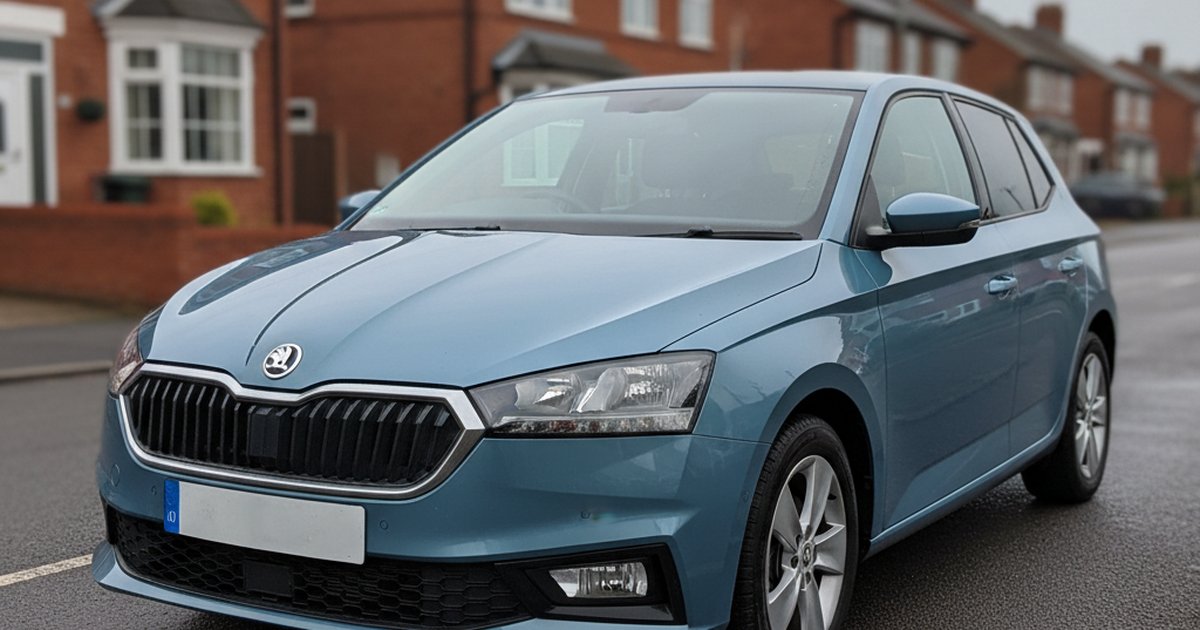
The Skoda Fabia has built a reputation as a sensible supermini choice, but our analysis of 1,716,262 MOT tests across 184,481 vehicles reveals a car with a split personality. Petrol versions consistently outperform their diesel siblings, and the gap is wider than you might expect.
We've crunched the numbers from the DVSA MOT database to show you exactly which Fabia models deliver on the promise of Czech reliability, and which ones will leave you searching for a good independent garage. The conclusion is straightforward: engine choice matters more than model year with the Fabia.
TL;DR: Petrol Fabias are significantly more reliable than diesels, scoring 609/1000 versus 536/1000. The 2012-2013 petrol models hit the sweet spot with pass rates above 82% and gentle ownership patterns (around 5,500 miles annually). Diesel versions suffer from dangerous defect rates above 40% and should be avoided unless you need the higher mileage capability.
Should you buy petrol or diesel?
This is not a marginal difference. Petrol Fabias consistently achieve pass rates 3-6 percentage points higher than equivalent diesel models across every year we analysed. More telling is the dangerous defect rate: diesels sit at 43-47% compared to 27-37% for petrols. That means nearly half of all diesel Fabias on the road have flagged at least one dangerous defect during their MOT history.
The ownership profiles explain part of this gap. Diesel Fabias average 7,600-8,200 miles annually versus just 5,200-5,800 for petrols. These are harder-working cars covering motorway miles, which accelerates wear on suspension components. Diesel models consistently show higher rates of worn suspension bushes and anti-roll bar linkage issues.
Annual mileage matters: Petrol Fabia owners treat these as city runabouts and shopping cars. Diesel buyers are after a different machine entirely, one that can handle daily commutes and longer trips. The MOT data shows the diesel engines and chassis cannot sustain this workload as reliably as the petrol alternatives.
Unless you genuinely cover over 15,000 miles annually, the diesel makes no financial sense. You will spend the fuel savings on suspension repairs and brake disc replacements, which appear as top defects on nearly every diesel model year.
Which years should you target?
The 2012-2013 petrol Fabias represent the peak of second-generation reliability. The 2012 model achieves an 82.2% pass rate with a reliability score of 634/1000, while 2013 scores 631/1000 with an 83.4% pass rate. Both years show owners averaging just 5,500-5,700 miles annually, suggesting these cars have led pampered lives.
These models sit at the end of the Mk2 production run, benefiting from years of manufacturing refinement while avoiding the teething issues that plague new platforms. Current examples typically show around 70,000-75,000 miles, placing them in the sweet spot for used buyers. Too low suggests limited use and potential for perished rubber components; too high means you are buying someone else's worn-out problems.
The 2015-2016 petrol models also perform well, with pass rates above 84%, though reliability scores drop slightly to 593/1000 and 546/1000 respectively. These represent early Mk3 cars, and the data shows they have not quite matched the sorted nature of the late Mk2 generation.
First MOT pass rates tell an interesting story about how well these cars age. The 2013 petrol drops from 89.5% at first test to 83.4% overall, a 6-point decline. That is actually modest wear for a supermini approaching 12 years old. Compare this to the 2014 diesel, where first MOT pass sits at 81.1% but overall hits just 79.4%. These cars degrade faster.
Which years should you avoid?
Every diesel Fabia from 2010-2018 shows reliability scores below 540/1000, with dangerous defect rates consistently above 38%. The 2017 and 2018 diesels are particularly poor, scoring just 416/1000 and 397/1000 respectively. These late-production diesels combine all the complexity of modern emissions equipment with the inherent fragility of small diesel engines used for short trips.
The 2018 petrol deserves caution despite its 85.2% pass rate. The reliability score of 461/1000 is the lowest we have seen for any petrol Fabia, and owners are covering 6,200 miles annually, higher than earlier petrols. This suggests a shift in buyer profile, with these cars working harder than the gentle-use examples from 2010-2015.
Post-2019 petrols show declining reliability scores (496/1000 for 2019, 477/1000 for 2020, 447/1000 for 2021) despite strong pass rates. This is a warning signal. First MOT pass rates remain solid, but the overall scores suggest these cars will not age as gracefully as the 2012-2013 generation. We suspect the shift to smaller turbocharged engines and more complex electronics is beginning to show in the data.
Sample size warning: The 2022 data covers just 647 vehicles with 853 tests. Too early to draw firm conclusions, though the 88.4% pass rate looks promising. Check back in two years when these cars hit higher mileages.
What goes wrong most often?
Tyres dominate the defect lists across all model years, appearing in the top three issues for every single variant. This is more about owner neglect than car design. Fabias wear tyres on the inner edge, a symptom of tracking issues and possibly aggressive kerbing in urban environments. Budget an extra £30-50 per MOT for alignment checks if you buy one of these.
Suspension bushes are the real mechanical concern. Front wishbone rear bushes appear consistently from 2011 onwards, affecting both petrol and diesel models. By 2012, this becomes the third most common defect on petrols. The issue is not whether these will need replacement, but when. Factor £200-400 for this work on any Fabia over seven years old.
Diesel models add brake disc scoring to the mix, with 22-27% of tests flagging worn or pitted discs. This is significantly higher than the 13-16% rate on petrols, likely because of the higher annual mileage and the tendency for diesel owners to delay brake servicing. A full brake refresh (discs and pads all round) costs £300-450 at an independent garage.
The 2015 diesel shows a particularly nasty defect: shock absorber fluid leaks appear in 18.4% of tests, classified as critical failures. This is abnormally high and suggests either a bad batch of components or owners pushing these cars harder than the suspension can handle. Replacement shocks cost £150-250 per axle fitted.
What will it cost to keep running?
Defects per test average 1.3-1.6 for petrol models, rising to 1.7-1.9 for diesels. Translate this into real money: expect to spend £100-200 annually on advisories and minor repairs for a petrol Fabia, climbing to £150-300 for a diesel. These are not big numbers in supermini terms, but they stack up over time.
The dangerous defect rates tell the insurance story. Petrols from 2015-2017 show rates below 28%, while diesels from the same period sit at 38-48%. AA breakdown data correlates with these MOT figures, showing diesel Fabias over-represented in callout statistics for suspension and brake failures.
Current mileage figures are instructive for residual value calculations. A 2012 petrol typically shows 75,000 miles, while the diesel equivalent hits 107,000. The diesel has covered 43% more distance in the same period, yet market values are within £500 of each other on Auto Trader. That is because buyers have wised up to the diesel penalty in MOT costs and future repairs.
Parts pricing favours the Fabia. As a volume Volkswagen Group product, components are widely available and competitively priced. Aftermarket support is excellent, particularly for petrols. Diesels suffer from more expensive injector and DPF issues that the MOT data does not fully capture until cars reach 10-12 years old.
What should you check before buying?
Run the registration through PlateInsight immediately. You get 5 free vehicle checks, and this will reveal the full MOT history including advisories that sellers conveniently forget to mention. Look for patterns: consistent tyre wear warnings suggest tracking problems, repeated brake advisories indicate an owner who defers maintenance.
Inspect the rear suspension bushes physically. Jack up the rear, grab the wheel at 9 and 3 o'clock, and pull in and out. Any movement beyond 2-3mm means the bushes are shot. This is a £300 job you can negotiate off the asking price. The MOT data shows this affects nearly every Fabia over 8 years old, so finding one with fresh bushes is a genuine selling point.
For diesels, insist on a DPF pressure test. The official MOT does not check DPF condition properly until it is completely blocked. A specialist test costs £40-60 but could save you a £1,200 DPF replacement. Given the dangerous defect rates on diesels, this is not optional due diligence.
Check service history for oil changes every 10,000 miles or annually, whichever comes first. The low annual mileage on petrol Fabias (5,200-5,800 miles) means they often miss time-based service intervals. Old oil kills engines. If the seller has no proof of annual oil changes, walk away or factor £800-1,000 off the price for potential engine wear.
Tyre condition matters more on Fabias than most superminis. The data shows 19-23% of all MOT tests flag tyre wear issues. Examine the inner edges of both front tyres. If they are noticeably more worn than the outer edges, the tracking is out and has been for some time. Budget £50 for alignment plus £120-160 for new tyres if the car is otherwise sound.
Found a year you like? A good year still hides a clocked odometer, outstanding finance or a past write-off. Before you hand over any money, check the exact Skoda Fabia.
Frequently asked questions
Are Skoda Fabias reliable cars in the UK?
Petrol Fabias are reliable with scores of 609-634/1000 for 2012-2013 models and pass rates above 82%. Diesel versions score poorly at 536/1000 or below with dangerous defect rates exceeding 40%. Engine choice matters more than model year for Fabia reliability.
What are the most common problems with Skoda Fabias?
Front suspension wishbone rear bushes wear by 80,000 miles on most models, affecting 12-15% of MOT tests. Tyres wear unevenly on inner edges requiring tracking adjustment. Diesel models suffer from brake disc scoring (22-27% of tests) and shock absorber leaks, particularly on 2015 diesels where 18.4% show fluid leaks.
Which Skoda Fabia engine is most reliable?
Petrol engines consistently outperform diesels with reliability scores 70-140 points higher and dangerous defect rates 10-20% lower. The 2012 petrol scores 634/1000 versus 522/1000 for the diesel equivalent. Petrol owners also cover half the annual mileage (5,500 vs 8,000 miles), reducing wear rates.
How many miles do Skoda Fabias typically last?
Petrol Fabias from 2012-2013 currently show around 75,000 miles with pass rates above 82%, suggesting they will comfortably reach 150,000 miles with proper maintenance. Diesel models at 107,000 miles show declining reliability scores and higher defect rates, indicating accelerated wear beyond 120,000 miles.
Is a high-mileage Skoda Fabia worth buying?
Petrol Fabias handle higher mileage better than diesels. Models with 80,000-100,000 miles still achieve 79-81% pass rates if petrol-powered. Avoid diesel Fabias above 100,000 miles as dangerous defect rates exceed 42% and suspension components are typically worn. Budget £500-800 for immediate suspension and brake work on any Fabia above 90,000 miles.
Our Verdict
The Skoda Fabia proves that badge snobbery costs money. These are fundamentally sound superminis when you pick the right specification, specifically the 2012-2015 petrol models. Our analysis of 1.7 million MOT tests shows they deliver Volkswagen Group engineering without the premium price tag, provided you avoid the diesel trap.
Before committing to any Fabia, use PlateInsight to check its complete MOT history. You get 5 free vehicle checks to review past failures, advisory patterns, and verify the seller's claims. Suspension bushes, tracking issues, and deferred maintenance show up clearly in MOT records. A £8,000 Fabia with a sketchy history is not a bargain; a £6,500 example with annual services and fresh bushes is.
You might also like
Check Any Vehicle's Full History
MOT results, mileage timeline, AI health score, and market valuations. New users get 5 free credits.