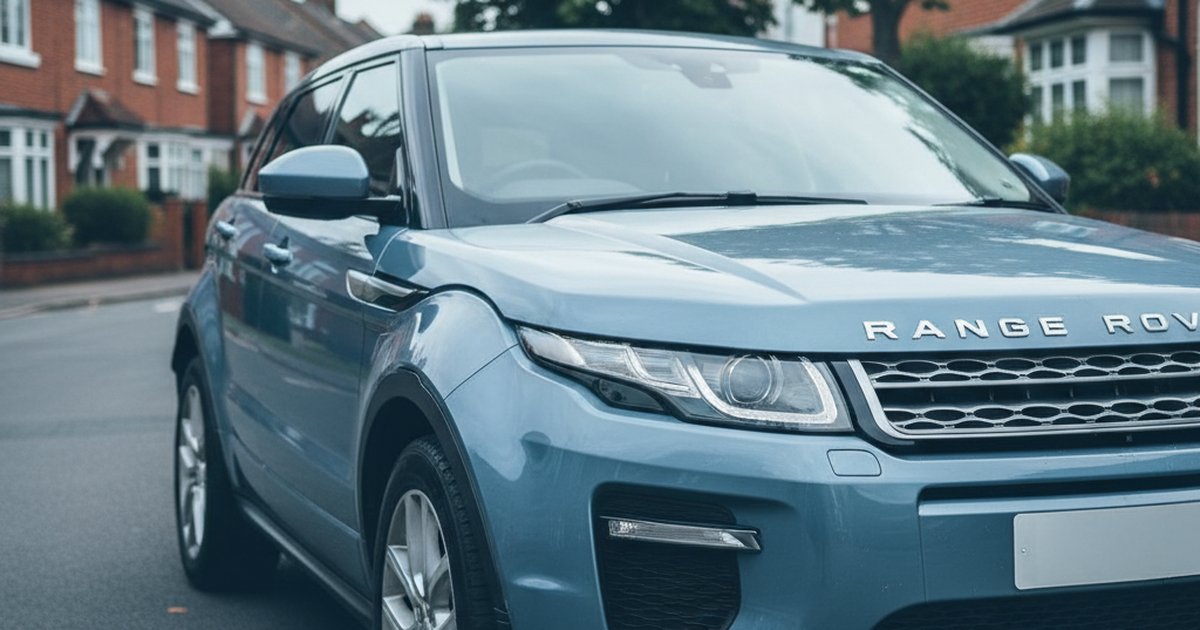
Living in west London, it's hard not to notice how common Range Rovers have become. Every other driveway has one. I've always wondered whether the "lesser" models, the Velars and Evoques, are just dining out on the brand perception built by the Autobiography, which has been the go-to car for the royals for decades. Does the engineering hold up, or is it all badge?
To find out, we analysed 1,230,667 MOT tests across 139,193 Evoques registered between 2011 and 2020. What surprised me most was the gap between petrol and diesel. Petrol Evoques are genuinely decent cars. Diesel Evoques are a different story entirely.
TL;DR: Petrol Evoques consistently outperform diesels, with 2016-2017 petrols achieving 90-91% pass rates versus 82-85% for early diesels. Brake discs corrode aggressively (affecting 22% of 2016-2018 tests), and every model year burns through tyres faster than you'd expect from a premium SUV. The 2020 diesel sample shows worrying early signs with just 484/1000 reliability.
Should you buy petrol or diesel?
Petrol Evoques pass MOTs at rates between 84% and 91%. Diesels manage 82% to 89%. The gap sounds small until you look at what's causing it. Petrol owners average 5,000-6,400 miles per year, diesel owners 7,300-7,600. The petrols live gentler lives and it shows at MOT time.
The 2016 petrol is our pick. 90.6% pass rate, 714 out of 1000 reliability score, and owners averaging just 5,084 miles a year. These are shopping-centre cars. The equivalent diesel from the same year only manages 87.8% passes.
The dangerous defect rates make the gap clearer. The 2017 petrol sits at 16.4%, the diesel at 25.3%. If you don't need a diesel for towing or motorway miles, buy petrol. The MOT data is unambiguous on this one.
Why do the brakes corrode so badly?
This one caught my attention. From 2016 onwards, "brake disc worn, pitted or scored" shows up in 19-22% of all MOT tests. The DVSA MOT history database confirms it's consistently the second most common defect across nearly every Evoque model year.
The reason is pretty straightforward. Evoque owners don't drive enough to keep the discs clean. The 2016 petrol averages 5,084 miles per year, which works out at 425 miles per month. The brakes sit idle, moisture gets in, surface rust forms, and by MOT time the discs are shot.
Budget £300-400 for front discs and pads around the fourth or fifth year. If you're looking at an Evoque with full Land Rover service history but no recent brake work, that cost is coming whether the seller mentions it or not.
What's wrong with the tyres?
Tyres are the number one defect across every single model year. Between 19% and 28% of all tests flag tyres worn close to the legal limit or worn on the edge. No other defect comes close.
Part of it is the rubber itself. Evoques run wide, low-profile 245/45 R20 tyres that look the part but wear quickly, especially with the high centre of gravity. Replacing all four every 15,000-20,000 miles is normal for this car. Edge wear in particular points to alignment problems, which seem to be a recurring theme.
A premium 245/45 R20 tyre costs £150-200 each. Four corners, every couple of years, and you're spending £600-800 just keeping it legal. The RAC recommends checking alignment after any pothole strike, which in Britain means you probably need it done annually.
Are 2011-2013 models worth buying?
Only if you enjoy throwing money at independent specialists. The 2011-2013 diesels pass between 82% and 83% of tests, with reliability scores stuck in the 640-700 range. These are old enough now (12-14 years) that major components are end-of-life.
The 2012 diesel is particularly grim. It scores just 666/1000 reliability despite being barely into middle age. First MOT pass rate was 85.8%, but by the time these cars rack up 107,000 miles (current median), they're picking up 1.4 defects per test. That's significantly worse than the Japanese competition.
The dangerous defect rate on early diesels is alarming. The 2011 diesel sits at 45.5%, the 2012 at 44.7%. Nearly half of all these vehicles on the road have had at least one dangerous fault flagged at some point. Suspension, steering, brakes - critical safety systems failing at rates that should concern anyone paying premium prices.
Key point: Early petrol models fare slightly better, but sample sizes are tiny (380 vehicles for 2011 petrol vs 3,913 diesels). You're buying into rarity without proven longevity.
Which years offer the best value?
If you're set on an Evoque, the 2016-2017 petrols are the ones to target. Pass rates of 90.6% and 91.1%, dangerous defect rates under 24%, and most of them have been used gently. These were bought as status cars, not off-roaders.
The mileages back this up. A 2016 petrol has a median of just 48,444 miles. That's a seven year old SUV averaging barely 7,000 miles a year. Most of them have spent their lives parked. The 2017 petrol is similar, 45,226 miles median and a 91.9% first MOT pass rate.
The diesel versions from the same years are noticeably weaker. The 2017 diesel manages 88.4% passes but only scores 624 out of 1000 for reliability, with a 25.3% dangerous defect rate. Diesel owners also average 7,286 miles per year, which is harder use and it shows.
Should you buy a 2018-2020 Evoque?
The 2018-2019 petrols still pass at 91-91.5%, but reliability scores are drifting down to 623-631 out of 1000. For cars this young, that's not great. They're already averaging 1.0 defects per test, which means the underlying problems haven't gone away with the facelift.
The 2020 diesel data is concerning, though the sample is small (50 vehicles, 133 tests). An 85% pass rate and 484 out of 1000 reliability at age three is poor for any modern car. We'll need another couple of years of data before we know if this is representative.
Worth noting: What Car? owner surveys suggest Evoque buyers tend to accept faults because they like the car. That's fine on a three year lease. Less fine if you're planning to keep one for a decade.
What are the true running costs?
On top of the brakes and tyres, suspension components and steering linkages come up regularly. Nothing catastrophic on its own, but when you're paying Land Rover parts prices it adds up fast.
Brake pads appear in 11-18% of all tests across model years. Combined with the disc corrosion, you're looking at a full brake refresh every 40,000-50,000 miles. Independent specialists charge £600-800. Main dealers want £1,200-1,500 for the same job.
Even diesel owners only average 7,300-7,600 miles per year. Most Evoques spend more time on driveways than motorways. They depreciate, the brakes corrode, the tyres wear, and the next owner picks up the bill. You need to be comfortable with that before buying one.
Found a year you like? A good year still hides a clocked odometer, outstanding finance or a past write-off. Before you hand over any money, check the exact Range Rover Evoque.
Frequently asked questions
Is the Range Rover Evoque reliable?
No, not by mainstream standards. Reliability scores range from 484-781/1000 depending on year and fuel type, with petrol models consistently outperforming diesels. Pass rates of 82-91% are mediocre compared to Japanese rivals.
What are the common problems with Range Rover Evoque?
Brake disc corrosion (affecting 19-22% of tests from 2016 onwards), excessive tyre wear (19-28% of all tests), and brake pad wear (11-18% of tests). Early diesels also show high dangerous defect rates above 44%.
Which is more reliable, petrol or diesel Evoque?
Petrol models consistently show 3-9 percentage points higher pass rates and significantly lower dangerous defect rates. The 2016-2017 petrols achieve 90-91% passes versus 88% for diesel equivalents.
How many miles does a Range Rover Evoque last?
Median current mileage ranges from 40,000-109,000 depending on age, but annual averages of just 5,000-7,600 miles suggest most won't see truly high mileage. Mechanical issues appear well before 100,000 miles on many examples.
Are used Range Rover Evoques worth buying?
Only if you accept premium running costs. Brake and tyre replacements are near-constant expenses, and reliability scores suggest significant repair costs between MOTs. Buy 2016-2017 petrol if you must have one.
Our Verdict
1.2 million MOT tests paint a pretty clear picture. Evoques are expensive to buy, expensive to run, and the badge does a lot of heavy lifting. If you're set on one, a low-mileage 2016-2017 petrol with full history is the only version I'd be comfortable recommending. Anything else and you're taking on someone else's maintenance backlog.
Before you buy any used Evoque, run a PlateInsight check. We'll show you the actual MOT history, flag what's likely to go wrong next, and score it against every other Evoque of the same age. You get 5 free checks to start.
You might also like
Check Any Vehicle's Full History
MOT results, mileage timeline, AI health score, and market valuations. New users get 5 free credits.