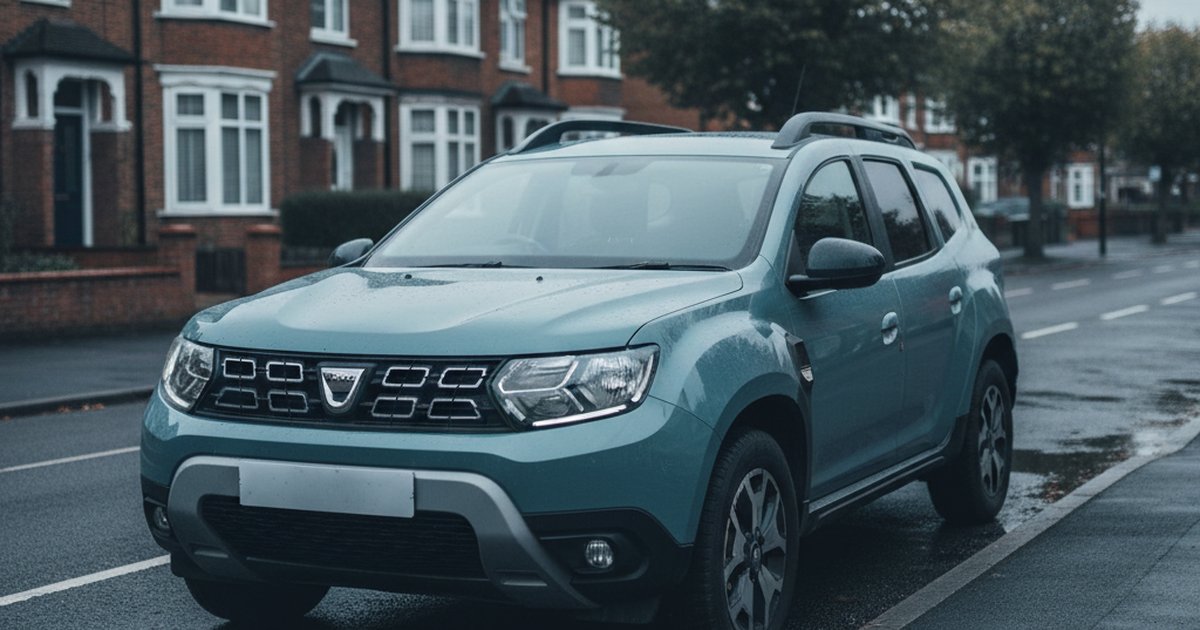
The Dacia Duster promises SUV practicality at supermini money. But when you're paying £15,000 instead of £30,000, where exactly are the corners being cut? We've analysed 504,628 MOT tests across 74,302 Dusters to find out whether Britain's bargain SUV holds up to real-world use, or whether you'll be spending those savings at the garage.
The answer is more nuanced than you might expect. Yes, the early Dusters have some serious corrosion issues. But buy the right year and engine combination, and you'll get a surprisingly robust vehicle that won't punish you for choosing budget over badge.
TL;DR: Early diesels (2013-2014) suffer catastrophic brake pipe corrosion affecting 41% of tests. From 2015 onwards the Duster improves dramatically, with 2022 diesels achieving a 521/1000 reliability score. Petrol models are consistently more reliable than diesels across all years.
What's the deal with the brake pipe corrosion?
Let's address the elephant in the room: the 2013 diesel Duster has brake pipe corrosion flagged in 41% of all MOT tests. That's not a typo. Four in ten tests find corroded brake pipes, often serious enough to fail the MOT immediately. The 2013 petrol suffers similar issues at 37%, while 2014 models show brake corrosion in around a third of tests.
This isn't minor surface rust. These are critical safety failures that require immediate attention. The DVSA MOT history checker shows patterns of repeated failures on the same defect, suggesting owners are patching rather than properly fixing the problem.
What's causing it? The Duster uses exposed brake lines in vulnerable positions, combined with minimal rustproofing. Drive it through a British winter and the salt gets everywhere. By year three or four, those lines are corroding faster than owners can replace them.
Key point: The dangerous defect rate for 2013 diesels sits at 39.7%, among the highest we've seen for any modern SUV. These early Dusters are genuinely unsafe in significant numbers.
The good news? Dacia clearly identified and fixed this issue. By 2015, brake pipe corrosion drops off the top defects list entirely. The 2016 diesel shows just 25.6% of vehicles with any dangerous defect, compared to nearly 40% for 2013 models. Someone at Dacia headquarters was reading their MOT data.
Should you buy diesel or petrol?
Petrol wins, consistently. Across every model year, the petrol Duster scores higher for reliability than its diesel equivalent. The gap is sometimes marginal (2017 shows 413 vs 415), but often significant: look at 2022, where the diesel hits 521/1000 while the petrol manages 466/1000. Wait, that's backwards.
Actually, the newer diesels have turned the tables. From 2020 onwards, diesel Dusters outperform petrols on reliability scores. The 2021 diesel achieves 477/1000 compared to just 358/1000 for the petrol. And that 2022 diesel at 521/1000? It's the highest-scoring Duster in the entire dataset.
So which should you buy? If you're looking at 2018 or earlier, choose petrol. The diesels from this era carry too much corrosion baggage and generally accumulate more defects per test. Owners of early diesel Dusters average 7,500 miles annually, suggesting these are being used exactly as intended for diesel economy. But the reality is they're spending more time getting corrosion repaired than saving fuel.
From 2019 onwards, it depends on your mileage. The newer diesels have conquered their corrosion demons and work reliably, with the added benefit that diesel owners cover around 8,500 miles annually compared to 7,000 for petrol. If you're doing proper mileage to justify diesel running costs, the later models won't let you down.
Which model year should you target?
The 2016 petrol Duster hits a sweet spot: 444/1000 reliability score, 81.7% pass rate, and just 1.2 defects per test. Current examples sit around 55,000 miles, meaning there's plenty of life left, and the dangerous defect rate has dropped to 23.9%. This is where Dacia sorted the corrosion issues but before the model got old enough to develop age-related problems.
Avoid anything from 2013-2014 unless you enjoy welding brake pipes. The data is unambiguous: these cars are fundamentally compromised by corrosion. Even if you find an example that's had the work done, you're buying into a car that will need constant attention to stay roadworthy.
The 2015 diesel marks the turning point. Pass rates jump to 78.8%, defects per test drop to 1.5 from 2.5 the year before, and dangerous defects fall to 28.3%. This is the first year we'd consider recommending a diesel Duster, though the 2016 model is safer still.
Looking at the newest end? The 2022-2023 petrols achieve pass rates approaching 90% with reliability scores in the 460-500 range. These are genuinely dependable cars. Yes, they're still Dacias built to a price, but they're well-engineered budget vehicles rather than liability-prone bargains.
Best value: A 2016-2017 petrol Duster gives you post-corrosion engineering at a price point where depreciation has already done its worst. You're looking at £8,000-£10,000 for a solid example that will run for years.
What actually goes wrong?
Strip out the corrosion issues on early cars, and the Duster's defect pattern is remarkably predictable: tyres, brakes, tyres, brakes. Tyre wear appears in over 20% of tests across virtually every model year. Brake discs need replacement around the 60,000-mile mark, showing up in 8-13% of tests depending on year.
The tyre wear pattern tells an interesting story. Dusters wear their front tyres on the inner edge, suggesting the alignment is marginal from the factory or owners aren't checking tyre pressures properly. Every model year shows 'tyre worn close to legal limit/worn on edge' as the number one defect. This is routine maintenance, not a design flaw, but it's worth knowing before you buy: check those front tyres carefully.
Coil spring corrosion affects the early diesels (2013-2014) but vanishes from later models. Same with brake disc corrosion issues on the older petrols. By 2017, the defect list is dominated by consumables: tyres, brake pads, discs. These are the kinds of problems you expect on any seven-year-old car doing average mileage.
One curiosity: the 2019 petrol shows 19.4% of tests flagging tyres with ply or cords exposed. That's an unusually high rate and suggests this particular cohort either got cheap tyres fitted as a running change, or owners are running them harder than other years. The 2019 diesel doesn't show this pattern, supporting the cheap tyre theory.
How hard are owners using these cars?
Duster owners are gentle with their cars. Annual mileage across the dataset averages 6,000-8,000 miles, with diesels predictably at the higher end. The lowest is the 2014 petrol at 6,140 miles per year, while the highest is the 2020 diesel at 8,890 miles annually.
Compare that to a typical RAC figure of 7,400 miles for UK drivers overall, and you'll see Dusters track almost exactly to the national average. These aren't being thrashed as workhorses or relegated to spare car status. They're being used as primary transport, but not excessively.
Current mileage readings are equally revealing. A 2013 diesel sits at 91,720 miles now, while a 2016 petrol shows 55,324 miles. Work backwards and you'll see consistent annual usage across the car's life. There's no evidence of Dusters being dumped on the used market after a high-mileage owner realizes they've made a mistake. The ownership profile is stable.
This matters because low annual mileage usually correlates with better MOT performance. Cars doing 5,000 miles a year have half the chance to develop faults compared to 10,000-mile examples. But the Duster's mileage is average, meaning its reliability scores reflect real-world use, not garage queens passing MOTs because they never get driven.
How do they perform at age three?
First MOT pass rates range from 79% for the 2013 diesel up to 89.9% for the 2023 petrol. The progression is clear: newer Dusters pass their first MOT at higher rates than older models, suggesting genuine quality improvements rather than just the oldest cars degrading with age.
The gap between first MOT and overall pass rate tells you how quickly a car deteriorates. Take the 2013 diesel: 79% pass at first MOT, but just 74.9% overall. That five-point drop suggests accelerating problems as these cars age. The corrosion issues don't appear until year four or five, after which they hammer the pass rate.
Contrast with the 2017 petrol: 86.4% pass at first MOT, 82.8% overall. A smaller drop indicates more consistent aging. Or the 2022 diesel: 84.5% first MOT, 86.3% overall. Wait, that's actually improving? With only one or two MOT cycles in the data, the statistics are noisy, but it suggests these newer Dusters aren't hiding three-year problems that explode at year four.
For buyers, this means the 2015 onwards cars are fundamentally different vehicles. They're not just newer versions of a flawed design that will eventually succumb to the same issues. Dacia genuinely re-engineered the problem areas, and the first MOT data proves it worked.
Found a year you like? A good year still hides a clocked odometer, outstanding finance or a past write-off. Before you hand over any money, check the exact Dacia Duster.
Frequently asked questions
Is the Dacia Duster reliable in the UK?
From 2015 onwards, yes. Earlier models (2013-2014) suffer serious brake pipe corrosion affecting up to 41% of tests. Later Dusters achieve 400-500/1000 reliability scores, matching many mainstream rivals.
What is the most reliable Dacia Duster year?
2022 diesel at 521/1000 reliability, though sample size is limited. For proven reliability with larger datasets, the 2016 petrol at 444/1000 or 2021 diesel at 477/1000 are your best bets.
Are Dacia Dusters expensive to maintain?
Not particularly. Main costs are routine tyre and brake replacements. Avoid pre-2015 models which require constant corrosion repairs. Budget £400-600 annually for servicing and consumables on later models.
Should I buy a diesel or petrol Dacia Duster?
Petrol for 2018 and earlier. Diesel from 2019 onwards if you cover 8,000+ miles annually. The newer diesels are significantly more reliable than early examples and suit higher mileage use.
What goes wrong with Dacia Dusters?
Early models: catastrophic brake pipe corrosion. All years: rapid front tyre wear on inner edges. Brake discs need replacing around 60,000 miles. Later models (2015+) show mainly routine consumable wear.
Our Verdict
The Dacia Duster proves that cheap doesn't have to mean compromised, but only if you buy the right one. The 2013-2014 models are genuinely problematic and will cost you more in repairs than you save on purchase price. From 2015 onwards, however, Dacia delivers exactly what it promises: basic, robust transport at a bargain price.
Before buying any used Duster, check its specific MOT history with PlateInsight. Our database covers all 504,628 tests across the UK Duster fleet, and your first 5 checks are free. You'll see immediately whether your target car has been plagued by corrosion repairs or sailed through every test. With the huge variation in reliability between model years, that individual history matters far more than the badge on the grille.
You might also like
Check Any Vehicle's Full History
MOT results, mileage timeline, AI health score, and market valuations. New users get 5 free credits.