Brake pads and discs are the most frequently replaced wear items on any car, but some models chew through them far faster than others. We've analysed 1,094,771 MOT tests across 40 popular car variants to identify which vehicles are costing owners the most in brake maintenance, and which are quietly racking up big mileages without a single pad change.
The results challenge several common assumptions. You might expect heavy SUVs to destroy brakes quickly, yet some of the worst offenders are mid-size crossovers and hatchbacks. Meanwhile, EVs occupy almost every spot in the top 20 best performers, thanks to regenerative braking doing most of the stopping work. For used car buyers, this data matters. A car with a 50% brake defect rate at MOT means you've got a coin flip's chance of needing new pads or discs at the next test. At £250 to £600 per axle, that adds up fast.
TL;DR: The Kia Carens (2013 diesel) has the highest brake defect rate at 52.4%, with issues appearing around 70,000 miles. Jaguars and Vauxhall crossovers fill the next spots, whilst electric cars dominate the cleanest records - the VW ID.3 Life logs just 1.78% defects. Regenerative braking on EVs and hybrids massively reduces pad wear, saving owners hundreds in maintenance costs.
Worst Cars for This Defect
Best Cars for This Defect
Why Do Some Cars Eat Brakes Faster Than Others?
Brake wear boils down to physics and engineering. Heavier cars need more braking force to stop, which should mean faster wear. But weight is only part of the equation. Brake specification matters more. A 1,500kg crossover with undersized single-piston front calipers will wear faster than a 2,000kg SUV with four-piston Brembos and 350mm ventilated discs.
The PSA Group cars at the top of our worst list (Citroen DS3, Peugeot 2008, Vauxhall Crossland) share platform components including brake hardware. They use relatively small front discs (266-283mm) and single-piston sliding calipers. These work fine for economy driving but struggle when owners regularly brake hard from motorway speeds. The pads overheat, glaze, and wear unevenly. The Kia Carens, topping the worst list, combines Korean brake components with owners averaging 8,114 miles per year in typical MPV use - school runs, supermarkets, lots of stop-start urban driving.
Rear drum brakes on some models also contribute to premature front wear. When the rears provide minimal braking force (as drums often do), the fronts do 80% of the work instead of the ideal 60-70% split. The result: front pads gone at 30,000 miles, rears still original at 60,000.
Electric vehicles flip the script entirely. Regenerative braking uses the motor as a generator to slow the car, converting kinetic energy back into battery charge. In typical driving, regens can handle 70-80% of braking events. The friction brakes only engage for emergency stops or the final few mph. This explains why our best performers list is almost exclusively EVs and plug-in hybrids. A VW ID.3 Life owner might reach 50,000 miles on the original pads, whilst a diesel Kia Carens needs new fronts at 35,000.
Which Cars Have the Worst Brake Defect Rates?
The Kia Carens 2013 diesel takes the unwanted crown, with brake-related defects flagged in 52.4% of MOT tests. Brake problems typically emerge around 70,000 miles on this model. The 2014 and 2015 diesel Carens follow close behind, suggesting a systemic issue with the braking system specification across this generation.
Jaguar's E-Pace fills positions two through four. The 2018 diesel logs a 51.5% defect rate, with issues starting at 41,400 miles. For a premium SUV costing £30,000-plus used, that's poor. The E-Pace uses the same braking hardware across petrol and diesel variants, but diesel models average more miles per year (7,700-8,150) compared to petrol versions. More miles, more brake applications, faster wear.
Vauxhall's Crossland X Griffin 2020 petrol achieves a 49.4% defect rate despite relatively low annual mileage of 6,803 miles. When problems appear by 32,680 miles on a car driven gently, it points to inadequate brake specification for the vehicle weight. The Crossland weighs around 1,350kg, yet uses the same brake setup as lighter Corsa models.
The PSA Group's DS3 (which became Citroen DS3) appears four times in the worst 20. These stylish small hatchbacks use economy-focused braking systems that simply cannot cope with spirited driving. The 2016 diesel DS3 shows a 48.8% defect rate with problems starting around 56,700 miles. Owners report frequent pad and disc replacement, often accompanied by brake judder from warped discs.
Land Rover's Discovery Sport appears twice, but context matters here. These are high-mileage vehicles (8,200-8,800 miles per year) often used for towing and country use. The 2018 diesel shows defects around 45,500 miles, but that represents heavy-duty use. The defect rate of 47.9% is still poor, but the mileage context is important when comparing against urban crossovers.
How Much Does Brake Replacement Cost?
Front brake pads and discs on a typical mainstream car cost £250-£350 fitted at an independent garage, £400-£500 at a dealer. Rears add another £220-£320 (independents) or £350-£450 (dealers). So a full four-wheel brake overhaul runs £500-£950 depending on where you go.
Premium and performance cars cost significantly more. Jaguar E-Pace brake discs and pads run £450-£600 for the fronts alone at a specialist, closer to £700-£800 at a Jaguar dealer. Land Rover Discovery Sport four-wheel brake work approaches £1,000 at main dealers. When our data shows these cars have brake defects in nearly 50% of MOT tests, those costs really mount up.
The cheapest option is pads-only replacement if you catch wear early. Front pads fitted run £80-£150 on most cars. But if you ignore the warning signs and grind metal-on-metal, you'll need new discs too. Many cars also need new hardware (pad retaining clips, anti-rattle shims) which adds £20-£40 per axle.
Brake fluid should be changed every two years regardless of mileage, costing £50-£80. Old fluid absorbs moisture, which lowers the boiling point and accelerates internal corrosion in calipers. Seized caliper pistons force you into a full caliper replacement (£150-£300 per side), turning a £200 pad job into a £600+ repair.
Electric cars offer huge savings here. With brake systems barely used thanks to regenerative braking, many EV owners reach 60,000-80,000 miles without touching the pads. That's £400-£600 saved compared to equivalent petrol or diesel models. The What Car? cost of ownership surveys confirm EVs have significantly lower brake maintenance costs over three years.
Why Do Electric Cars Have Such Low Brake Wear?
Regenerative braking transforms EV brake longevity. When you lift off the accelerator in an EV, the motor switches to generator mode, creating resistance that slows the car whilst putting charge back in the battery. In many EVs you can drive using only the accelerator pedal, barely touching the brake.
Our data proves the real-world impact. The VW ID.3 Life logs brake defects in just 1.78% of MOT tests. The BMW 330e (plug-in hybrid) sits at 2.0%. Kia e-Niro variants occupy three spots in the top 20 best, at 3.3-4.4% defect rates. These cars are not fitted with exotic brake systems. They use conventional discs and calipers. The difference is how rarely those components actually work.
Tesla Model 3 brake pads typically last 100,000+ miles according to owner reports. Our data shows just 3.5% defect rate despite an impressive median of 38,564 miles already covered and owners averaging 31,417 miles per year. These cars are being driven hard and far, yet the brake hardware barely wears.
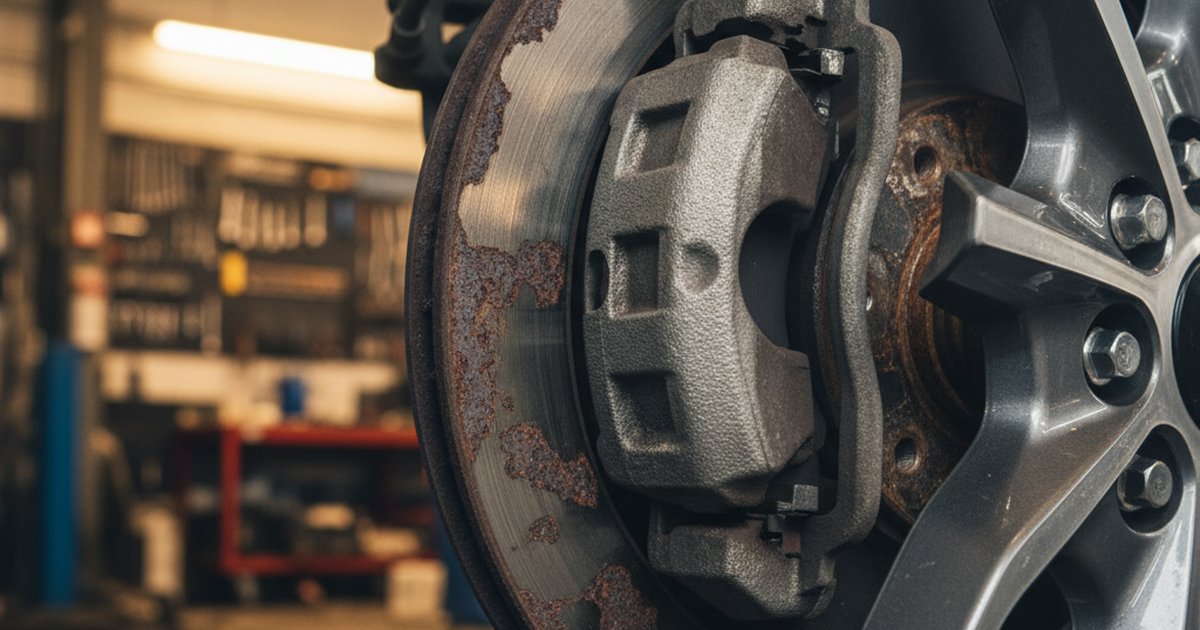
One side effect: EVs can suffer from surface corrosion on brake discs because they're used so infrequently. You'll spot orange rust on the disc surface. This is cosmetic and cleans off after a few hard stops, but it can cause advisory notices at MOT if the corrosion is deep. Some EV manufacturers now programme occasional automatic friction brake activation to keep the surfaces clean.
Hybrids gain similar benefits, though less dramatically. The Lexus UX hybrid shows a 3.9% defect rate, whilst the Toyota C-HR hybrid logs 3.75%. These cars use regens for much of their braking, extending pad life to 60,000-70,000 miles versus 30,000-40,000 for pure petrol equivalents. When comparing running costs between petrol and hybrid versions of the same car, factor in an extra brake replacement cycle for the petrol over 80,000 miles.
What Causes Premature Brake Wear?
Driving style matters more than most owners realise. Heavy braking from high speed generates tremendous heat. Pads rated for 400°C can hit 600°C+ under hard motorway braking. At these temperatures, the pad material crystallises and loses friction. The glazed surface skates over the disc instead of gripping it, forcing you to brake harder, generating more heat, creating a vicious cycle.
Urban stop-start driving wears brakes differently. Constant moderate braking from 30mph never lets the components cool properly. The pads and discs stay warm all day, accelerating oxidation and wear. This explains why the Vauxhall Crossland and Citroen C3 Aircross (both urban crossovers averaging under 6,000 miles per year) show such high defect rates. These are school-run specials getting murdered by traffic queues.
Brake caliper design plays a major role. Single-piston sliding calipers (found on most economy cars) use one piston to push the inner pad against the disc, with the caliper body sliding on pins to pull the outer pad against the other side. These pins corrode and seize, preventing the caliper from releasing fully. The outer pad drags constantly, wearing unevenly and overheating. You'll spot this as one pad worn to the metal whilst the other looks nearly new.
Multi-piston fixed calipers (four or six pistons) push both pads evenly and never need to slide. They're found on performance and premium cars but cost more to manufacture. A BMW with four-piston front brakes will outlast a Vauxhall with single-piston sliding calipers, all else being equal. The BMWs in our best performers list benefit from better brake hardware despite their higher performance potential.
Rear drum brakes on budget cars are cheaper to make but provide poor braking force. Models like the base-spec Peugeot 2008 use drums at the rear, forcing the front discs to do most of the work. The fronts wear out at 35,000 miles whilst the rear drums are barely touched at 70,000. Rear discs cost more but balance the braking load properly, extending front pad life significantly.
How Do the Worst and Best Compare?
The contrast between worst and best performers is staggering. Here's a direct comparison of the extremes:
| Car | Defect Rate | Earliest Mileage | Annual Mileage |
|---|---|---|---|
| Kia Carens 2013 diesel | 52.4% | 69,934 | 8,114 |
| Jaguar E-Pace 2018 diesel | 51.5% | 41,400 | 7,734 |
| Vauxhall Crossland X Griffin 2020 | 49.4% | 32,680 | 6,803 |
| DS DS3 2016 diesel | 48.8% | 56,695 | 7,265 |
| Citroen DS3 2013 diesel | 47.8% | 67,407 | 7,254 |
| VW ID.3 Life 2021 | 1.8% | 34,181 | 7,668 |
| BMW 330e 2020 | 2.0% | 49,140 | 10,780 |
| BMW X3 xDrive20d 2021 | 2.3% | 33,958 | 8,608 |
| BMW 5 Series 2019 PHEV | 2.7% | 57,867 | 11,454 |
| Kia e-Niro 2021 | 3.3% | 61,828 | 12,290 |
The VW ID.3 Life has a defect rate 29 times lower than the Kia Carens despite similar annual mileage. The BMW models in the best list are driven harder (10,000-11,000 miles per year) than the PSA Group cars in the worst list (6,800-7,200 miles) yet show defect rates 20 times lower. This is not about gentle driving. It's about brake system design and regenerative technology.
The Jaguar E-Pace result is particularly damning. This premium SUV costs twice what a Vauxhall Crossland does new, yet it develops brake defects at 41,400 miles at a similar rate to the Vauxhall. For context, our overall reliability rankings show the E-Pace scoring poorly across multiple categories, not just brakes.
What Should You Inspect When Buying Used?
Check brake disc condition first. Acceptable discs have a smooth, uniform grey surface with no grooves deeper than 1mm. Run your finger across the disc surface (when cold). You should feel a slight lip at the outer edge where the pad hasn't contacted the disc. If that lip is 2mm+ high, the discs are worn and need replacement soon. If you feel deep grooves or the surface is rough like sandpaper, walk away. That car needs immediate brake work costing £400+.
Inspect pad thickness through the wheel spokes if possible. Most pads start at 10-12mm thick. They're legally worn out at 1.5mm. Budget for replacement at 3mm because you don't want to be forced into an emergency repair. If you can't see the pads clearly, insist on a test drive and listen. Any squealing or grinding noise during braking means the pads are finished.
Check the brake fluid reservoir under the bonnet. The fluid should be clear or light amber. If it's dark brown or black, the system has not been serviced properly. Old fluid accelerates corrosion inside brake calipers, leading to seized pistons and expensive caliper replacement. Budget £400-£600 extra for a full brake system overhaul if the fluid looks neglected.
Test the brake pedal feel on a test drive. The pedal should be firm within the first third of travel. If it sinks slowly to the floor or feels spongy, there's air in the system or a fluid leak. This is a serious safety issue requiring immediate attention. Also test the handbrake on a hill. It should hold the car securely without the lever pulled to its maximum height.
The DVSA MOT history checker shows brake-related advisories and failures. Look for patterns. One brake advisory at 40,000 miles is normal. Multiple brake advisories at every MOT since 30,000 miles suggests the owner has ignored warnings and deferred maintenance. Those bills will land on you.
For cars on our worst performers list, assume you will need brake work within 10,000 miles unless the seller provides receipts for very recent replacement. A Jaguar E-Pace at 38,000 miles with no brake history? Budget £500-£700 for new front pads and discs. A Kia Carens at 65,000 miles? Probably needs a full four-wheel overhaul at £700-£900. Factor these costs into your offer price.
What Were the Surprising Results?
The complete absence of heavy traditional SUVs from the worst list surprised us. You'd expect Land Rover Defenders, Range Rovers, and large Mercedes SUVs to eat brakes given their 2,500kg+ kerb weights. Yet they don't crack the top 20 worst. This is down to proper brake specification. A Range Rover uses massive 380mm ventilated front discs with multi-piston calipers that handle the weight easily.
Meanwhile, relatively lightweight crossovers (1,300-1,500kg) dominate the worst list because manufacturers fit economy-spec brakes to hit price points. The Vauxhall Crossland weighs 1,350kg but uses brake hardware sized for a 1,200kg Corsa. The result: a 49.4% defect rate by 32,000 miles. An honest heavyweight SUV with properly-sized brakes outlasts a lightweight crossover with undersized components.
The Jaguar E-Pace cluster was unexpected. Jaguar trades on premium credentials and charges premium prices, yet the E-Pace brake system performs worse than budget mainstream cars. The 2018-2020 E-Pace diesel models all show 48-52% defect rates. For a car costing £35,000-£45,000 new, that's unacceptable. Jaguar should have specced better brake hardware for a vehicle of this weight and performance.
Electric BMWs dominating the best performers list is particularly interesting because these are high-mileage cars driven hard. The 330e averages 10,780 miles per year, the 5 Series PHEV does 11,454 miles per year. These are not garage queens. Yet their brake defect rates sit at 2.0-2.7%, proving regenerative braking works in real-world conditions. The plug-in hybrid system saves owners £300-£400 in brake maintenance over 50,000 miles compared to pure petrol equivalents.
The Kia e-Niro achieving a 3.3% defect rate at 61,828 miles whilst averaging 12,290 miles per year is remarkable. This is a proper high-mileage workhorse, yet the brake system is barely touched thanks to regenerative braking. For fleet buyers and high-mileage drivers, the running cost advantage of EVs extends well beyond fuel savings. You can read more about overall reliability patterns in our MOT failure rates by brand guide.
Want to know if the car you're viewing has a history of this? Its MOT record shows every advisory and failure, free to check.
Frequently asked questions
How often should brake pads be replaced?
On conventional petrol or diesel cars, front brake pads typically last 30,000-40,000 miles, rears 50,000-60,000 miles. On EVs and hybrids with regenerative braking, pads often last 60,000-100,000+ miles. The cars on our worst list need replacement at 25,000-35,000 miles.
Can I just replace brake pads without replacing discs?
Yes, if the discs are not worn beyond minimum thickness and have no deep scoring or cracks. Mechanics measure disc thickness with a micrometer. If the discs are within spec and the surface is smooth, pads-only replacement costs £80-£150 per axle vs £250-£350 for pads and discs together.
Why do some brake pads wear unevenly?
Usually caused by seized caliper slide pins. The caliper cannot move freely, so one pad drags constantly whilst the other barely contacts the disc. You'll see one pad worn to the metal and the other looking nearly new. This requires caliper service (cleaning and lubricating the pins) or replacement if the pins are too corroded.
Do heavier cars always wear brakes faster?
No. Our data shows lightweight crossovers with undersized brake systems wear faster than heavy SUVs with properly-specified brakes. A 1,350kg Vauxhall Crossland shows a 49.4% defect rate, whilst 1,800kg+ BMWs log 2-4% rates. Brake specification matters more than weight.
How do I know if my brake discs are worn?
Check for a raised lip at the outer edge of the disc where the pad hasn't contacted the metal. A lip over 2mm indicates worn discs needing replacement. Also look for deep grooves, cracks, or rust patches. Any vibration or pulsing through the brake pedal when stopping suggests warped discs.
Our Verdict
Brake wear is one of the most predictable maintenance costs in car ownership, but our MOT data reveals massive variation between models. A Kia Carens owner faces brake work every 35,000 miles at £500+ per time. A VW ID.3 owner might reach 70,000 miles on the original pads. Over 100,000 miles of ownership, that's a £1,500+ saving just on brakes.
For used car buyers, checking brake condition before purchase is non-negotiable. Use PlateInsight to run a vehicle history check before viewing any car on our worst performers list. You get 5 free credits when you download the app. Our checks pull full MOT history including all brake-related advisories and failures, helping you spot deferred maintenance before it becomes your expensive problem. A car with multiple brake advisories in recent MOTs is telling you something. Listen to the data and walk away, or negotiate a hefty discount to cover the inevitable repair bills.
You might also like
Check Any Vehicle's Full History
MOT results, mileage timeline, AI health score, and market valuations. New users get 5 free credits.