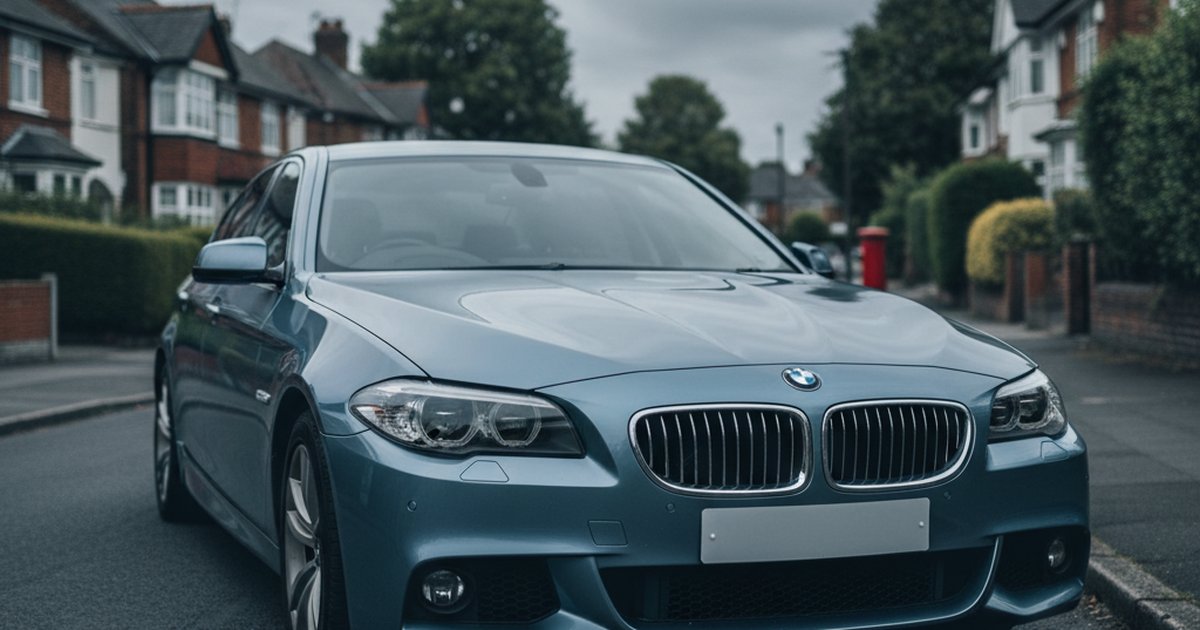
The BMW 5 Series is the default choice for business buyers who want a premium executive saloon without the ostentation of a 7 Series. Over 76,000 examples are on UK roads, and we've analysed every single MOT test - 513,062 of them - to work out which generation and which fuel type you should buy.
The data tells a clear story: petrol models consistently outperform diesels, the G30 generation (2017 onwards) shows measurable improvements over the F10 (2010-2016), and the plug-in hybrid (badged as 'Electric' in DVLA records) has a serious reliability problem that BMW won't tell you about in the brochure.
TL;DR: Buy a 2012 or 2014 F10 petrol if you want proven reliability (796 and 816 scores respectively), or stretch to a 2020-2021 G30 petrol for 91-94% pass rates. Avoid plug-in hybrids entirely - they score 506-631 across all years with dangerous defect rates above 30%. Diesels are acceptable if bought carefully, but never match petrol dependability.
F10 vs G30: which generation should you buy?
The F10 (2010-2016) and G30 (2017-2023) are fundamentally different cars. The F10 was BMW's last purely analogue 5 Series, while the G30 introduced driver assistance tech, gesture controls, and a level of electronic complexity that shows in the MOT data.
First MOT pass rates tell the story. F10 diesels from 2012-2014 enter their first test at 84-93% pass rates, then degrade to 81-87% overall as they age. The G30 diesels reverse this pattern slightly - they start strong at 87-91% on first MOT, then settle at 89-90% long-term. That consistency matters if you're buying a higher-mileage example.
Petrol F10s are the real winners. The 2012 and 2014 models score 796 and 816 reliability points, with pass rates of 85-87%. These cars average just 6,100-6,400 miles per year according to DVSA records, suggesting gentle ownership by drivers who chose petrol deliberately rather than defaulting to diesel company car tax logic.
G30 petrols can't match those scores (611-678 range), but they compensate with stronger first-time pass rates of 89-93%. If you're buying nearly new, the G30 petrol is fine. If you want a proven seven-year ownership proposition, the F10 petrol has the data to back it up.
Do diesel 5 Series actually last longer?
No. The conventional wisdom that diesel executive saloons are more durable doesn't survive contact with the MOT data. Across every single year from 2010 to 2023, petrol models outscore diesels on reliability. The gap ranges from 35 points (2017) to 125 points (2013).
Dangerous defect rates expose the problem. F10 diesels from 2010-2013 show 40-42% of vehicles flagged with at least one dangerous defect over their lifetime. The petrol equivalents sit at 15-30%. That's not marginal - it's a pattern of diesel-specific failures that petrol owners simply don't experience.
The defect profiles differ too. Diesels fail on brake pads and suspension components far more frequently than petrols. An F10 diesel averages 1.3-1.5 defects per test, while petrols manage 0.9-1.1. Multiply that across a typical 10-12 MOT tests over a car's lifetime and you're looking at 5-6 additional defects to fix on a diesel.
Mileage patterns explain part of this: diesel 5 Series average 9,500-10,250 miles per year versus 6,000-7,500 for petrols. Higher annual mileage means more wear, but it doesn't explain why 2017 diesels with identical 9,482 miles/year usage score 690 versus 644 for petrols at 6,682 miles/year. The petrols are working less hard and lasting longer.
What's wrong with the plug-in hybrid?
The 530e plug-in hybrid (listed as 'Electric' in DVLA data, though it has a petrol engine) is the worst-performing 5 Series by a considerable margin. Across 2017-2023 model years, these cars score 506-631 reliability points - comfortably below every diesel and petrol equivalent.
Shock absorber failures are the smoking gun. Over 14% of 2018 plug-in hybrid tests flag 'shock absorbers has light misting of oil' as a defect. The 2019 models show 9.0% with the same issue. Conventional 5 Series models rarely exceed 6-7% on this metric. The additional 200kg+ battery weight is destroying suspension components faster than BMW's engineers predicted.
Tyre wear is equally problematic. The plug-in hybrids show 24-26% of tests flagging worn tyres, versus 14-22% for conventional petrols. That extra weight again, combined with instant electric torque shredding front tyres. Budget £800-1,000 per year extra for tyres if you buy a 530e.
Dangerous defect rates stay above 30% for 2017-2019 plug-in hybrids, only dropping to 21% for 2020 and 12% for 2021-2022. Even the newest examples underperform their petrol siblings. According to What Car? owner satisfaction data, 530e drivers report similar frustrations with battery degradation and complex electronics.
The only scenario where a 530e makes sense: you have free workplace charging and do 90% of your mileage on short urban trips under 20 miles. Otherwise, you're paying a £5,000-8,000 premium over an equivalent 530i petrol for the privilege of worse reliability and higher running costs.
Which specific years should you target?
Best years:
- 2014 F10 Diesel (816 score): The single highest-scoring diesel 5 Series in our dataset. Pass rate of 87.8%, first MOT pass of 93.9%, just 1.0 defects per test. Only 180 vehicles in the database, so rare, but worth searching for.
- 2012 F10 Petrol (796 score): More common than the 2014 diesel with 254 vehicles tested. Pass rate of 85.8%, only 1.0 defects per test, and current examples average just 76,204 miles despite being 11-12 years old.
- 2021 G30 Petrol (678 score, 94.5% pass rate): If you want something newer with a warranty remaining, this is your target. First MOT pass of 93.4% and only 0.5 defects per test - the lowest in the entire dataset.
Years to avoid:
- 2013 F10 Diesel (675 score): The worst-performing diesel year with 40.1% dangerous defect rate and 1.3 defects per test. Nearly 78,900 tests in our data, so you'll encounter plenty of these - walk away.
- Any plug-in hybrid 2017-2020 (506-526 scores): Shocking reliability for what should be a premium product. The 2018 model is particularly grim at 517 with 33.2% dangerous defect rate.
- 2010 F10 Diesel (750 score): Not terrible, but the 40.3% dangerous defect rate is concerning, and these cars now average 139,457 miles. You can do better.
What actually fails on a 5 Series?
Tyres dominate the defect lists across all years and fuel types. Between 14-26% of all MOT tests flag worn or damaged tyres, with 245/45R18 and 225/55R17 run-flats being the usual culprits. Run-flat tyres cost £180-250 each, and the 5 Series chews through them faster than rivals because of its rear-biased weight distribution and enthusiastic owners.
Brake pads appear in 5-8% of tests, which is actually reasonable for an executive saloon with 18-19 inch wheels and 300-400kg more kerb weight than a 3 Series. Budget £300-400 per axle for OEM-quality pads.
Suspension arm ball joints show up in 7-10% of F10 tests (2010-2016 models), but drop to 2-4% for G30 cars. BMW clearly improved the design. F10 owners should inspect lower rear arms carefully - this is a £400-600 repair per side if you're unlucky.
The shock absorber epidemic on plug-in hybrids is unique to that model. Conventional 5 Series rarely see shock absorber failures before 100,000 miles unless they've been driven hard on poor roads.
Is a high-mileage 5 Series worth buying?
Depends entirely on fuel type and service history. A 2012 F10 petrol with 120,000 miles and full BMW dealer history is a better buy than a 2018 530e plug-in hybrid with 45,000 miles and patchy independent servicing.
Current median mileages from our data: F10 diesels average 117,000-139,000 miles (2010-2013 models), F10 petrols average 61,000-76,000 miles (same years), and G30 diesels sit at 61,000-79,000 miles (2017-2019). The petrols have done 30-40% fewer miles because they attract lower-mileage private buyers rather than company car fleet drivers.
Annual mileage patterns matter more than total mileage. A 2012 diesel at 150,000 miles that's been doing 9,500 miles per year consistently is fine - that's motorway commuting, low stress, regular servicing. A 2017 diesel at 95,000 miles that's jumped from 6,000 to 15,000 miles per year recently suggests a change of ownership pattern that may not end well.
The RAC breakdown data shows 5 Series diesel DPF failures spike after 90,000 miles if the car hasn't been doing regular long runs. Check the exhaust for sooty deposits and insist on a regeneration cycle test drive before buying any diesel above 80,000 miles.
What do 5 Series actually cost to run?
Based on the defect data, budget £600-900 per year for MOT-related repairs on an F10 petrol, £800-1,200 for an F10 diesel, £700-1,000 for a G30 petrol, and £1,200-1,800 for a plug-in hybrid. These figures assume you're fixing advisories proactively rather than waiting for failures.
Tyre costs are unavoidable. The 5 Series wears through run-flats every 15,000-20,000 miles based on the MOT data showing 20-26% of tests flagging tyre wear. Four tyres at £200 each is £800, so annual tyre spend is £600-800 if you're doing the 9,500-mile diesel average, or £400-550 if you're doing 6,500 miles per year in a petrol.
Service costs follow BMW's condition-based servicing, which means oil changes every 12,000-18,000 miles depending on usage. Expect £300-400 for an oil service at an independent specialist, £500-600 at a BMW dealer. The N57 diesel engine (2010-2016) requires AdBlue top-ups every 5,000 miles at £15-20 per refill.
Insurance is Group 30-35 for F10 models, 32-38 for G30 cars. Plug-in hybrids sit in Groups 33-36 but attract higher premiums because of expensive battery repairs - insurers know what we know about shock absorber failures and suspension stress.
Found a year you like? A good year still hides a clocked odometer, outstanding finance or a past write-off. Before you hand over any money, check the exact BMW 5 Series.
Frequently asked questions
Which is more reliable, the F10 or G30 5 Series?
F10 petrols (2010-2016) score higher on reliability (796-816 for 2012-2014 models) than G30 petrols (611-678 for 2020-2021). However, G30 diesels show more consistent pass rates (89-90%) compared to F10 diesels (81-87%). If buying petrol, choose F10. If buying diesel, G30 is marginally better.
Are BMW 5 Series expensive to maintain?
Based on 513,062 MOT tests, budget £600-900 annually for repairs on F10 petrols, £800-1,200 for F10 diesels, and £1,200-1,800 for plug-in hybrids. Tyre costs add £400-800 per year. Petrol models average 0.9-1.1 defects per test versus 1.3-1.5 for diesels, meaning lower ongoing maintenance.
Should I buy a high-mileage diesel 5 Series?
Only if it has full service history and has been doing consistent motorway miles. DPF failures spike after 90,000 miles on cars used for short journeys. Our data shows diesel 5 Series average 9,500-10,250 miles per year, so a 2017 model at 70,000-80,000 miles is normal. Above 100,000 miles, inspect exhaust for soot deposits and test DPF regeneration.
What's wrong with the 530e plug-in hybrid?
Reliability scores of 506-631 (versus 641-796 for conventional petrols), dangerous defect rates above 30% for 2017-2019 models, and shock absorber failures affecting 9-14% of tests due to extra battery weight. Tyre wear is also 20-30% higher than petrol equivalents. Only consider if you have free charging and do mostly short urban trips.
Which 5 Series engine is most reliable?
The 2012 and 2014 F10 petrol models score 796 and 816 reliability points respectively, with pass rates of 85-87% and only 1.0 defects per test. These vastly outperform diesel equivalents (675-750 scores) and plug-in hybrids (506-631 scores). The petrol engines also average 40% lower annual mileage, indicating gentler use.
Our Verdict
The 5 Series data reveals a simple truth: petrol models are measurably more reliable than diesels, and plug-in hybrids are actively problematic. Target a 2012 or 2014 F10 petrol if you want proven dependability, or a 2020-2021 G30 petrol if you prefer something newer with manufacturer support still available. Avoid the 530e plug-in hybrid unless you enjoy expensive shock absorber replacements and premature tyre wear.
Before buying any 5 Series, run a PlateInsight check to see its complete MOT history, mileage validation, and defect patterns. Every new user gets 5 free vehicle checks to make smarter buying decisions backed by real DVSA data, not dealer promises.
You might also like
Check Any Vehicle's Full History
MOT results, mileage timeline, AI health score, and market valuations. New users get 5 free credits.