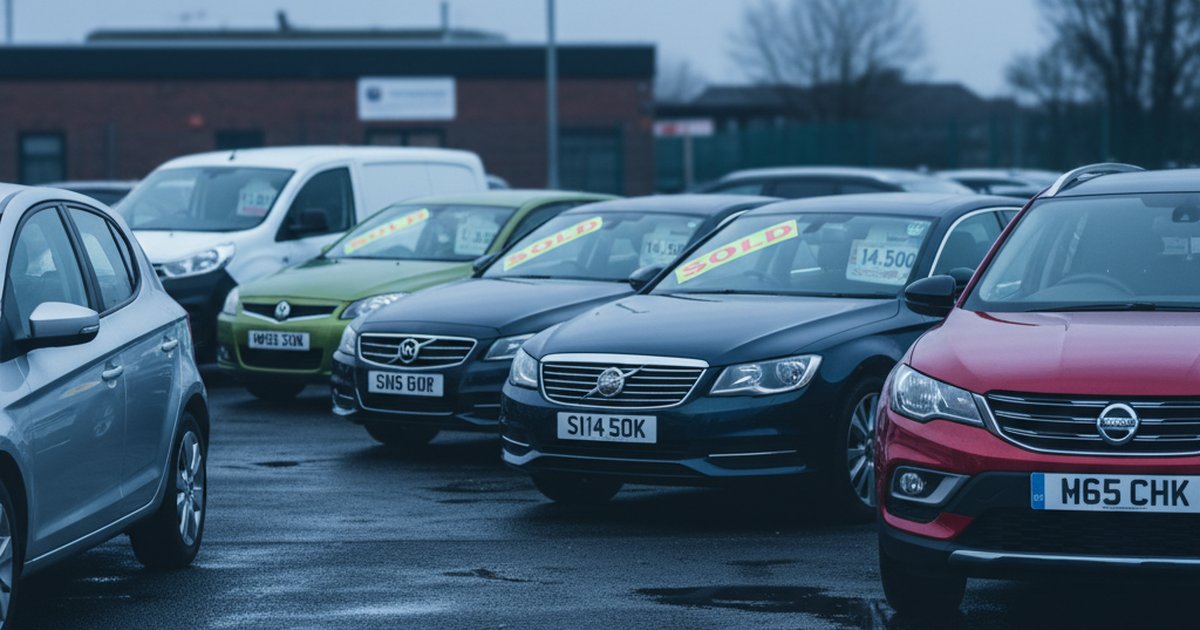
The used car market between £10,000 and £15,000 is where nearly new meets sensible money. Cars from 2019 to 2021 have depreciated from their original prices but still offer modern tech and low mileage. The question is: which ones will keep passing MOTs without drama?
We analysed 6,640 MOT tests across 3,156 vehicles in this age bracket to find out. The data reveals a clear pattern: diesel SUVs dominate the reliability rankings, but there are some surprising omissions and a few commercial vehicles you definitely don't want on your driveway.
Price estimates are based on typical market values for this model year range. We rank by MOT data, not valuations, but most cars here fall within the £10k-£15k bracket when shopping today.
TL;DR: Volkswagen, Audi and Seat diesel SUVs sweep the top positions, with the VW T-Roc R-Line TDI scoring a perfect 1000/1000 reliability rating. Most top performers average around 10,000 miles per year and show 98%+ first MOT pass rates. Avoid commercial vehicles in this price range unless you need one for work, they're here because of age, not value.
What makes this age bracket special?
Cars from 2019 to 2021 occupy a sweet spot in the used market. They're old enough to have shed 40-60% of their original value, but young enough that most are still on their first owner or just entering the second-hand market. More importantly for reliability, they're now hitting their first and second MOTs, which gives us real-world data on how they're holding up.
The 2019 models in our dataset are particularly revealing. They've had multiple MOT tests, giving us a proper sample size to judge build quality and durability. According to DVSA MOT records, first MOT pass rates tell you about factory quality, while subsequent tests show how well the car ages.
One pattern jumps out immediately: diesel still rules this segment. Every single car in our top 20 runs on diesel. That's not a coincidence. Buyers in this price bracket in 2019-2021 were choosing larger family SUVs and executive cars, and diesel made financial sense for the higher mileage these vehicles typically cover. Petrol hybrids were still expensive, and full EVs hadn't reached critical mass.
Which brands dominate the reliability rankings?
Volkswagen Group owns this list. Between VW, Audi and Seat, they occupy 13 of the top 20 positions. The VW T-Roc appears twice in the top 15, the Audi Q5 appears three times, and the Tiguan twice. This isn't badge engineering creating duplicates, either. These are genuinely different trim levels and model years, all performing exceptionally well.
The Volkswagen T-Roc R-Line TDI sits at the top with a perfect 1000/1000 reliability score. Owners average just under 10,000 miles per year, suggesting these are family second cars rather than motorway workhorses. Every single vehicle in our sample passed its first MOT, and the overall pass rate sits at 99.4%.
Key finding: Audi Q5 buyers can choose between three different variants in our top 20 (2019 S Line, 2020 S Line 40, and 2019 S Line 40), all scoring above 960/1000. The newer 2020 model scores marginally better despite fewer tests, suggesting consistent build quality across model years.
The Korean contingent makes a showing with the Kia Sportage at number 17, scoring 948/1000. That's still excellent, but tellingly it's the only non-European brand in the entire top 20. Japanese reliability, so dominant in older used car guides, doesn't appear here at all.
Should you avoid commercial vehicles in this price range?
Here's where the data gets interesting. Several commercial vehicles appear in our rankings: the Wrightbus Streetdeck (a double-decker bus), various Volvo trucks, an Iveco Daily van, and a VW Caddy. They score highly because they're well-maintained fleet vehicles with regular servicing schedules. The Wrightbus, for example, averages 32,000 miles per year and still maintains a 98.3% pass rate.
But you're not buying a double-decker bus for the school run. These vehicles appear in our dataset because they're the right age (2019-2021), not because they're sensible family transport. The Volvo FM truck currently shows 319,190 miles on the clock. Yes, it passes MOTs reliably, but it's done nearly half a million kilometres in five years.
Reality check: The Iveco Daily van shows the highest defect rate in our top 20 at 0.5 defects per test. That's still low, but 17.8% of tests flag worn suspension bushes, suggesting these vans work hard for a living. Unless you're running a trade business, stick to the SUVs.
The VW Caddy van at number 6 is the exception. It's a genuine consideration if you need commercial vehicle tax benefits but want car-like driving. With 14,695 miles per year and a 97.1% first MOT pass rate, Caddy owners use them as intended: local deliveries and light commercial work, not cross-country hauling.
How much are owners driving these cars?
Annual mileage tells you everything about ownership profiles. The SUVs in our list cluster tightly around 10,000 miles per year. The Audi Q2 averages 9,792 miles annually, the Seat Ateca 9,813 miles, and the VW T-Roc SE 10,417 miles. These aren't company cars racking up motorway miles. They're family vehicles doing school runs, supermarket trips, and weekend getaways.
Compare that to the Mercedes E 220 D at number 19, which averages 9,682 miles per year. That's surprisingly low for an executive saloon. Traditional E-Class buyers used to cover 15,000+ miles annually, but this data suggests younger diesel saloons are being used more conservatively. The shift to SUVs has pushed high-mileage drivers into Audi Q5s instead.
The Peugeot 3008 GT Line at number 10 shows slightly higher usage at 10,462 miles per year, but still modest compared to older diesel habits. What's remarkable is that despite this relatively gentle use, the first MOT pass rate hits 99.3%, the highest of any passenger car in our rankings. What Car? owner reviews confirm strong satisfaction with 3008 reliability in this generation.
What about Land Rover reliability?
The Land Rover Discovery Sport Landmark sneaks in at number 20 with a 938/1000 reliability score. That's genuinely impressive for a brand that historically struggles in reliability surveys. The first MOT pass rate hits 98.6%, suggesting Land Rover sorted their quality control issues by 2019.
But context matters. This particular variant, the Landmark edition, was a well-specced special edition aimed at retail buyers, not fleet managers. These owners likely baby their cars and maintain them properly. The annual mileage of 10,626 miles supports this, it's being used as a lifestyle SUV, not a workhorse.
Compare this to older Discovery Sports from 2015-2017, which show significantly worse MOT records in other PlateInsight data. The 2019 Landmark benefits from mid-cycle improvements to the Ingenium diesel engine and better electronics. It's not bulletproof, but it's no longer the reliability disaster Land Rover once fielded.
Which model years should you target?
The 2019 models have the most test data because they've been through multiple MOTs. The VW Tiguan R-Line from 2019, for example, has 397 tests across 162 vehicles, an average of 2.45 tests per vehicle. That's solid data. The 2021 Tiguan R-Line, by contrast, has just 226 tests across 217 vehicles, barely one test each. Most 2021s are only just hitting their first MOT.
Here's the pattern: 2019 models show slightly lower reliability scores than 2020-2021 versions, but that's because they've been tested more thoroughly. The 2019 Audi Q5 S Line 40 scores 960/1000 with 755 tests, while the 2020 version scores 972/1000 with only 288 tests. That's not better engineering in 2020, it's fewer opportunities to fail.
Buying strategy: Target 2019 models if you want the longest reliability track record and lower prices. Choose 2020-2021 if you prefer lower mileage and can afford the premium, but understand you're buying on limited MOT evidence. The RAC recommends pre-purchase inspections on any car under four years old precisely because MOT history is thin.
The Kia Sportage 2 from 2019 shows this perfectly. It has 404 tests (strong sample) and scores 948/1000, with a first MOT pass rate of 96.7%. That's a full two percentage points lower than most competitors, suggesting Kia's build quality, while good, isn't quite matching the VW Group standard in this segment.
What actually goes wrong with these cars?
The top performers show remarkably few defects. The 2021 Volvo (the truck, not a car) averages zero defects per test, with only 1.6% of tests flagging tyres worn close to the legal limit. That's as close to perfect as MOT data gets.
When things do go wrong, it's predictable stuff. The Iveco Daily van shows suspension arm bushes wearing at 17.8% of tests, a common commercial vehicle issue. The 2019 Volvo truck flags worn tyres at 6.1% of tests and brake pads wearing thin at 2.0%, exactly what you'd expect from a vehicle covering 36,000 miles per year.
The passenger cars tell a different story. We don't have detailed defect data for most of them because defect rates are so low they're not worth recording. The Audi Q2, VW T-Roc, and Seat Ateca all show first MOT pass rates above 98%, which means fewer than one in fifty cars has anything wrong at age three. That's exceptional.
Dangerous defect rates across the board sit below 1%. The only vehicle breaking this pattern is the 2019 Volvo truck at 0.8%, and even that's not concerning, it's one dangerous defect across 294 tests. For context, DVSA data shows the UK average dangerous defect rate sits around 1.5% for all tested vehicles.
Are diesel SUVs worth the running costs?
Every car in our passenger vehicle rankings runs on diesel. With low emission zones expanding and fuel prices volatile, that's a consideration. But the data shows these particular diesel SUVs are used conservatively. At 10,000 miles per year, you're looking at around 750 litres of diesel annually in a Q5 or Tiguan. That's manageable.
The bigger question is depreciation. A 2019 Audi Q5 S Line worth £35,000 new now trades around £22,000-£25,000 depending on mileage. That's £10,000-£13,000 lost over five years. The reliability data suggests you won't lose much to repairs, but diesel residuals are weakening as buyers shift to hybrid and electric.
The VW Group's MQB platform (which underpins the T-Roc, Tiguan, Q2, Q5, and Ateca) was designed for diesel efficiency. These 2.0 TDI engines in the real world return 45-55 mpg, making them genuinely economical for family use. The low annual mileage in our data suggests owners aren't doing the kind of long motorway runs that diesel was designed for, yet reliability remains strong. That speaks to robust engineering.
One thing to watch: adBlue systems. These diesels use adBlue injection to meet emissions standards, and the systems can be troublesome. Our MOT data doesn't flag widespread adBlue issues yet, but these cars are only 3-5 years old. The problems typically emerge at 6-8 years when sensors and injectors start failing.
How do these compare to petrol alternatives?
Here's what's missing from our top 20: petrol engines. Not a single one. That's not because petrol cars from 2019-2021 are unreliable, it's because diesel dominated this market segment and price point. The buyers choosing £30,000-£40,000 SUVs in 2019 overwhelmingly picked diesel for the torque and fuel economy.
Petrol alternatives do exist in this age range. The VW Tiguan 1.5 TSI, Audi Q5 40 TFSI, and Peugeot 3008 1.2 PureTech all sold in reasonable numbers. But they don't appear in our dataset here because we're looking at the most reliable examples based on MOT data, and the sample sizes for petrol variants are smaller.
What we can say is this: if you're buying for low mileage urban use, a petrol version of these same models makes financial sense. You'll pay slightly more to buy (petrol residuals are strengthening), but you'll avoid diesel particulate filter issues and adBlue complexity. Check PlateInsight's individual model reports for petrol variants using your free credits.
A reliable model is only half the story. The exact car you buy could be clocked, on finance, or a past write-off. Check it before you commit.
Frequently asked questions
Are these cars actually under £15,000?
Most are, but prices vary by condition and mileage. A 2019 VW T-Roc with 60,000 miles typically sells for £12,000-£14,000. The Audi Q5s command £20,000+, so check current market prices. We rank by reliability data, not valuations.
Why are there no petrol or hybrid cars in the rankings?
Diesel dominated the mid-size SUV market in 2019-2021. Our dataset reflects what buyers actually purchased at that time. Petrol variants exist but in smaller numbers, making the sample sizes insufficient for this particular analysis.
Is 10,000 miles per year considered low mileage?
For diesel SUVs, yes. These engines were designed for 15,000+ miles annually. The low usage in our data suggests owners are using them as family cars rather than business vehicles, which partly explains the excellent reliability scores.
Should I worry about diesel bans in city centres?
Most of these 2019-2021 diesels meet Euro 6d standards and aren't affected by current low emission zones. However, regulations will tighten over the next 5-10 years. If you live in a major city, check your local clean air zone rules before buying.
Why does the VW T-Roc score higher than the mechanically similar Audi Q2?
Sample size and luck. Both score above 990/1000, which is statistically indistinguishable. The T-Roc had 312 tests vs the Q2's 255, giving us more confidence in the data, but both are excellent choices.
Our Verdict
The nearly-new used car market offers genuinely reliable transport if you pick carefully. The VW Group's diesel SUVs dominate because they combine modern engineering with proven durability, backed by real MOT data from thousands of tests. Avoid the temptation to stretch your budget to a premium badge unless the reliability data supports it, the Seat Ateca delivers the same engineering as the Audi Q5 for significantly less money.
Before you commit to any purchase, run the specific registration through PlateInsight. We offer 5 free vehicle checks so you can verify the exact MOT history, mileage progression, and defect record of the car you're viewing. General model reliability is one thing, but individual vehicle history tells you what really matters: has this particular car been looked after?
You might also like
Check Any Vehicle's Full History
MOT results, mileage timeline, AI health score, and market valuations. New users get 5 free credits.