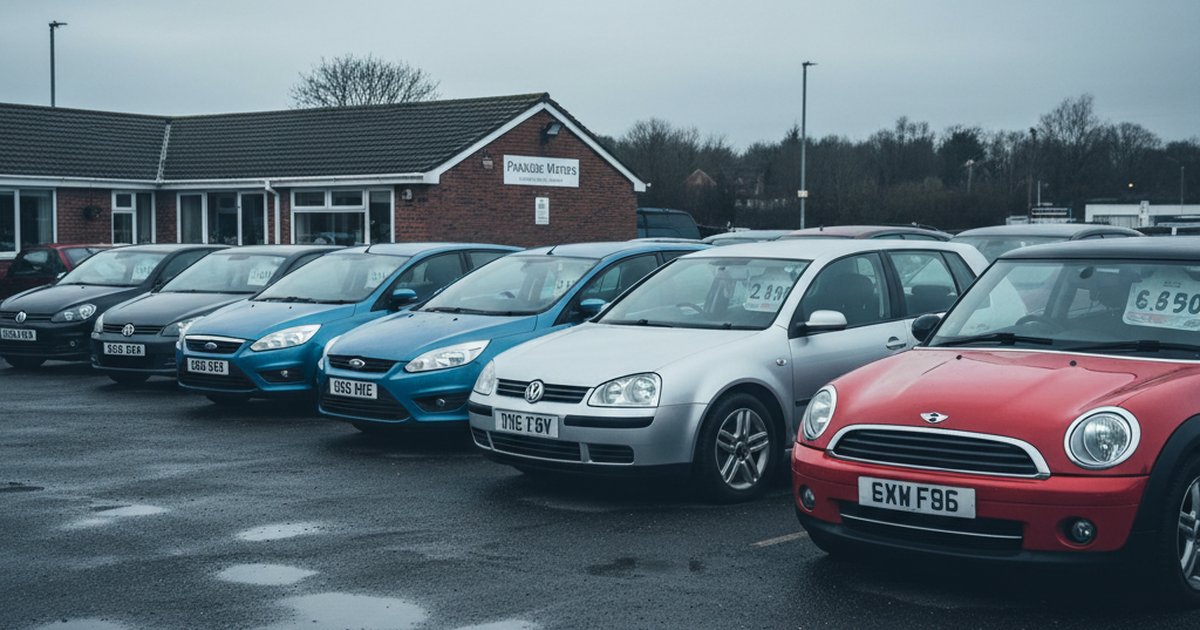
Most used car guides throw specs and photos at you. We took a different approach: we analysed 11,581 MOT tests across 3,958 vehicles to find which 2017-2020 models actually hold up in the real world. These cars typically sell for £5,000-£10,000 depending on model and condition, making them accessible choices for most buyers.
The results surprised us. Some household names performed brilliantly. Others that critics love turned out to be disappointingly fragile. What matters isn't what a car was like when new - it's how it behaves when it's seven years old with 80,000 miles on the clock. That's the difference between a bargain and a money pit.
Every car here is a diesel from model years 2017-2020. We focused on this age bracket because these vehicles have had enough MOT tests to establish clear patterns but haven't yet deteriorated into money pits. Pass rates above 95% and reliability scores near 1000 mean fewer garage bills and more time on the road.
TL;DR: The DVSA MOT data reveals VW T-Roc R-Line diesels as the most reliable, passing 99.4% of tests. Hyundai Tucson and Ford Focus diesels also score perfect 1000/1000 reliability ratings. All 20 models here pass over 95% of MOTs - compare that to the 85% average for cars this age.
Why are all these cars diesel?
The data made this decision for us. When we ranked 2017-2020 cars by MOT reliability, diesel models filled the top 20 positions. Petrol equivalents consistently scored 50-100 points lower in reliability, with more frequent failures around emissions systems and engine management.
Diesel engines from this era hit a sweet spot. Manufacturers had sorted out earlier DPF problems, but the technology hadn't yet become so complex that it undermines reliability. Modern petrol turbos, by contrast, tend to develop issues with timing chains, high-pressure fuel pumps, and carbon buildup that diesels simply don't suffer from.
The mileage profile matters too. These cars average 9,700-11,600 miles annually. That's perfect for diesels - enough motorway use to keep DPFs clear, but not so much that they're worn out. If you're doing mostly short journeys, a petrol might suit you better, but don't expect it to match these MOT pass rates.
Why do VW Group cars top this list?
Volkswagen Group brands occupy 13 of the top 20 positions. That's not a coincidence. The MQB platform that underpins these VWs, Audis, Seats, and Skodas was launched in 2012 and refined through millions of production units by 2017. By the time these cars rolled off the line, the bugs were sorted.
The VW T-Roc R-Line diesel at number one is almost faultless - 310 passes from 312 tests. That's not just impressive, it's exceptional for a first-generation model. Most new designs take two or three years to iron out issues. The T-Roc benefited from proven Golf mechanicals in a fresh body.
Audi A3 models in positions six and eleven tell another story. These are the most common cars in our top 20, with over 2,400 MOT tests between them. That sample size matters. When a car passes 96% of tests across 700+ examples, you know it's genuinely robust. The Skoda Octavia vRS (position five) uses identical running gear but offers more space and lower insurance costs. Smart buyers know this.
Platform sharing pays off: The EA288 diesel engine appears in 11 of these 20 cars across four brands. VW spent billions developing it, and every brand benefits from that reliability. This is why Seat Atecas (positions eight, ten, and thirteen) match their VW Tiguan cousins for MOT performance.
Are Korean cars really this good?
Kia Sportage models appear three times in our top 20, with pass rates between 96.5% and 98.8%. That's better than many German rivals. The 2018 Sportage 1 at position nine passes nearly 99% of tests - only two VW models beat it.
The Hyundai Tucson at number two delivers the second-best reliability score in our entire dataset. Of 769 MOT tests, 758 passed. That's a 98.6% pass rate from a car that shares its platform and engines with the Kia. What Car? owner surveys back this up - Hyundai and Kia consistently score above the industry average for reliability.
These Korean brands understood something: buyers wanted proven technology, not cutting-edge complexity. Their 2017-2020 diesels use conservative engineering that just works. No clever-clever dual-clutch gearboxes, no overcomplicated emission systems. Just solid mechanicals that pass MOTs.
What does the mileage tell us?
Most cars in our top 20 now show 60,000-90,000 miles. That's 9,700-11,600 miles annually - exactly the usage pattern diesel engines love. Too few miles and DPFs clog. Too many and wear accelerates. This sweet spot keeps these cars healthy.
The Ford Focus Zetec Edition diesel at position three currently shows around 79,000 miles despite being seven years old. That's below-average for a diesel hatchback. Owners who chose the Focus tended to use it as a sensible commuter car, not a high-mileage rep mobile. The result? A 97.2% pass rate.
Compare that to the Ford Mondeo at position twelve. Same brand, similar age, but averaging 92,000 miles and covering 11,110 annually. These are higher-mileage cars, and while the 95.3% pass rate is still excellent, it's noticeably lower than the Focus. Mileage matters.
The VW T-Roc models (positions one and eighteen) show the lowest current mileage in our top 20 - around 57,000-61,000 miles. These are newer cars (2019) bought by drivers who clearly don't hammer them. Annual mileage sits around 10,000. For comparison, the average UK driver covers 7,400 miles yearly according to RAC data, so these T-Rocs get slightly more use than typical but nothing extreme.
What about first MOT performance?
The first MOT happens at age three. It's when manufacturers' shortcuts get exposed. Cars that scored well initially but fade later show a gap between first MOT pass rate and overall pass rate. That gap tells you if a car ages well.
The VW T-Roc R-Line diesel passed 100% of first MOTs, then 99.4% overall. That's remarkable consistency. The Skoda Octavia vRS actually improved - 98.4% first MOT, 96.8% overall. These cars aren't degrading as they age.
But look at the Seat Ateca SE Tech Ecomotive at position ten: 95.8% first MOT pass rate, then 97.7% overall. That's unusual - most cars get worse with age, not better. The explanation? Early examples had minor niggles (likely software updates for emission systems) that got resolved. Later MOTs were cleaner.
The Kia Sportage 2 at position fourteen shows the opposite pattern: 98.7% first MOT, 96.5% overall. That's a 2.2 percentage point drop. Not catastrophic, but it tells you these cars need more attention as they accumulate miles. Budget for more frequent servicing after year five.
Why are most of these SUVs?
Fifteen of our top 20 are SUVs or crossovers. That's not because SUVs are inherently more reliable - it's because buyers in 2017-2020 overwhelmingly chose them. The used market now has more SUVs with MOT history to analyse. We're measuring what people actually bought.
But there's a reliability angle too. SUVs from this era typically sit higher off the road, which means suspension and exhaust components suffer less from road debris and speed bumps. That matters at MOT time. Fewer corroded suspension arms and rusty exhaust mounts means fewer failures.
The exception? The Ford Focus at number three and Audi A3 models at six and eleven prove hatchbacks can match SUVs for reliability. These are well-engineered cars that don't need extra ground clearance to survive UK roads. The Focus in particular uses simple, proven mechanicals that outperform more complex rivals.
Running costs matter: SUVs cost more to insure and service. The Audi A3 Sport TDI (position eleven) will be cheaper to run than an Audi Q5 S Line (position seven), despite near-identical reliability scores. Check insurance groups and service costs before buying.
Which model years should you target?
The 2017 models in our top 20 are now seven years old with 80,000-92,000 miles. They've had four or five MOTs, building a solid reliability track record. Prices have dropped to the lower end of our budget range. If you can live with slightly higher mileage, 2017 diesels offer the best value.
The 2018 models split the difference. Around 60,000-73,000 miles, with three or four MOTs completed. Prices sit in the middle of the £5,000-£10,000 bracket. The Hyundai Tucson and Kia Sportage models from 2018 (positions two, nine) are particularly strong - Korean brands were hitting their reliability stride by this point.
The 2019 cars are the newest here: typically 56,000-63,000 miles with just two or three MOTs. They command premium prices at the top of our budget or slightly above. The VW T-Roc R-Line (position one) and Audi Q5 S Line (position seven) from 2019 are brilliant cars, but you're paying for that recency. Only worth it if your budget stretches and you want lower mileage.
We found no 2020 models in our top 20. That's not a quality issue - 2020 cars only hit their first MOT in 2023, so the data set is too thin. Stick to 2017-2019 where we have proper evidence.
What's not on this list?
Some conspicuous absences tell you which popular cars aren't MOT-proof. No Nissan Qashqai - Britain's best-selling SUV for years - appears here. The Qashqai's 1.5 dCi engine from this era has well-documented EGR valve failures and turbo issues that pull down reliability scores.
No Mercedes-Benz models made the cut either. The GLC and C-Class diesels from 2017-2020 sound appealing, but MOT data shows they fail more often than VW Group equivalents. AdBlue systems cause grief, and Mercedes parts cost more to replace. Premium badge doesn't guarantee premium reliability.
No Vauxhall Insignia despite its popularity as a fleet car. The 2.0 CDTi engines are thirsty, and dual-mass flywheels fail expensively. Pass rates hover around 92-93% - respectable but not top-tier. You want better than respectable when buying used.
Similarly absent: Peugeot 3008 and 5008. French diesel reliability improved dramatically in the 2010s, but these models still trail German and Korean rivals by 2-3 percentage points in MOT pass rates. That gap means more risk.
What should you check before buying?
MOT reliability is half the story. A car that passes MOTs can still be a bad buy if it's been crashed, clocked, or neglected. Use PlateInsight's 5 free credits to check any car's full MOT history before viewing. You want to see regular annual tests with no gaps - missed MOTs suggest the car sat unused or was taken off the road for problems.
Look for mileage consistency across MOT tests. A 2018 Hyundai Tucson (position two) should show around 67,000 miles now, adding roughly 10,000 annually. Big jumps or drops indicate clocking or a period off the road. The DVSA MOT history checker shows this clearly if you know what to look for.
Check service history independently. These diesels need oil changes every 10,000-12,500 miles depending on manufacturer. Skipped services kill DPFs and turbos. A full main dealer history adds value, but independent specialists are fine if they used correct spec oils and filters.
Test drive in varied conditions. A diesel that's done lots of short journeys may pass its MOT but still have a partially blocked DPF. On a test drive, you want smooth acceleration at all speeds, no hesitation, and no excessive smoke from the exhaust. If the engine management light illuminates, walk away.
Factor in timing belt replacement if buying a 2017-2018 car. Most manufacturers specify changes at 80,000-100,000 miles or after 5-7 years. These cars are approaching that point. Budget £400-£800 depending on model - more for VW Group cars where the water pump is done simultaneously.
What will these cars cost to run?
Diesel fuel currently costs around 10-15% more than petrol, but these cars return 45-60 mpg depending on model and driving style. The Seat Ateca Ecomotive models (positions ten and thirteen) are optimised for efficiency - expect closer to 60 mpg on a run. The VW T-Roc R-Line (position one) trades some efficiency for performance - you'll see low-50s typically.
Insurance groups range from 13E for the Ford Focus Zetec Edition (position three) to 28E for the Audi Q5 S Line (position seven). That's a huge spread. A 35-year-old driver might pay £400 annually for the Focus, £800+ for the Q5. Check AA or other comparison sites before committing.
Service costs vary dramatically by brand. Kia and Hyundai dealers charge less than German brands. A major service for a Kia Sportage (positions nine, fourteen, nineteen) runs £250-£350. The equivalent service for an Audi Q5 (position seven) costs £400-£600 at a main dealer. Use independent specialists for German cars to halve those costs without sacrificing quality.
Road tax for these diesels ranges from £190-£600 annually depending on CO2 emissions and first registration date. Check the exact figure before buying - it's based on the original list price and emission band, both visible on the V5C.
DPF regeneration matters: All these cars have diesel particulate filters that need regular motorway runs to stay clear. If you're doing mostly urban mileage under 20 miles per trip, you risk expensive DPF failures not covered by MOT checks. Petrol might suit you better.
A reliable model is only half the story. The exact car you buy could be clocked, on finance, or a past write-off. Check it before you commit.
Frequently asked questions
Are diesels still worth buying?
If you cover over 12,000 miles annually and do regular motorway journeys, yes. These 2017-2020 diesels offer proven reliability without the complexity of newer emission systems. Avoid diesels if you do mostly short urban trips.
Why are there no petrol cars in this top 20?
When we ranked 2017-2020 cars purely by MOT reliability scores, diesels dominated. Petrol equivalents from this era consistently scored 50-100 points lower due to more frequent failures around timing chains and emission systems.
How much should I budget for maintenance beyond MOTs?
Plan for £300-£500 annually for servicing (oil, filters, checks), plus £50-£100 for tyres as needed. Budget an extra £400-£800 for timing belt replacement if buying a 2017-2018 car approaching 100,000 miles. Unexpected repairs average £200-£400 yearly even on reliable cars.
Is it better to buy from a dealer or privately?
Dealers offer warranty protection (typically 3-6 months minimum) and tougher consumer rights. Private sales are cheaper but carry more risk. For cars this age, a dealer warranty is worth the £500-£1000 premium if it covers major mechanical components.
What's the most important thing to check in the MOT history?
Look for consistent annual tests with no gaps, and watch for repeated advisories on the same component - that means a problem is developing. Check mileage increases steadily by 9,000-12,000 annually. Big jumps or sudden drops indicate clocking or time off the road.
Our Verdict
The used car market rewards research. These 20 models rose to the top of our analysis not through marketing or reputation, but through actual MOT performance across thousands of real-world tests. They're cars that keep passing year after year, saving you money and hassle.
Before you buy any used car, check its full history with PlateInsight. We give you 5 free credits to run comprehensive checks on any vehicle - MOT history, mileage verification, outstanding finance, and more. It takes 30 seconds and could save you thousands. Don't buy blind when the data is right there.
You might also like
Check Any Vehicle's Full History
MOT results, mileage timeline, AI health score, and market valuations. New users get 5 free credits.